
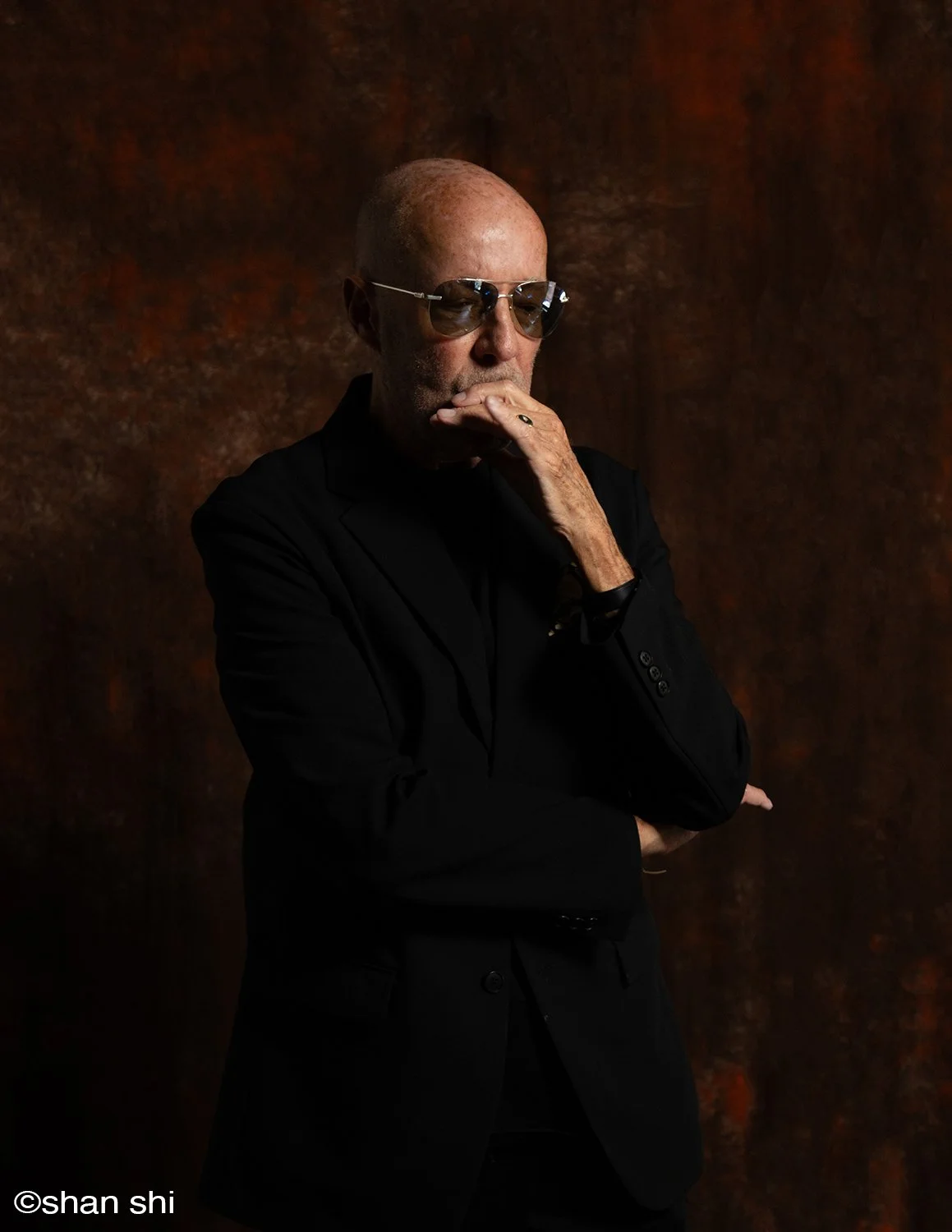
interview
michael james o’brien
chair of photography
at the savannah college of art and design / scad
photographer, teacher, curator, poet and activist
atlanta, usa
How do you define your role in the photography world?
The photography world isn’t monolithic so it’s challenging to assess anyone’s place in it. Standards of comparative evaluation that existed previously are constantly replaced. I have always made work about overlooked or misrepresented communities that I am part of (or adjacent to) or practitioners that I consider integral to my own growth & the life of our culture. All my work is about visibility, accountability, personal history from a queer perspective.
To quote E.M. Forster’s famous description of Constanine Cavafy, “A Greek gentleman in a straw hat, standing absolutely motionless at a slight angle to the universe.”
That’s how I see myself (but without the straw hat).
Why do you do what you do?
E.M. Forster again (From Howard’s End): “We must be willing to let go of the life we have planned, so as to have the life that is waiting for us”. For me, growing up in NYC, verbal & visual & performative expression were a given from a very early age & my family never ran interference on that. So, I did the gamut from painting (bad) to theater (not bad but too competitive) to writing at Kenyon College & then photography at Yale. Writing & photography really stuck because they combined both visual & literate awareness of, & connection to, the phenomenological world. As an only child, that was, & is, deeply important to me. To look, hopefully to see; to process verbally & visually & to present the result of that intertwined process.
Where do you look at photographic work? How do you discover new artists?
There are so many opportunities for online research which is a great advantage now, but I like to see as much as I can IRL . So, in NYC, it’s the International Center of Photography, the Whitney, Jack Shainman, Baxter Street (Camera Club of New York), Gladstone- to name a few. In London, PHOTO LONDON (where SCAD Photo has exhibited for 6 years), TATE Modern, Gilbert & George Centre, the Galleries around Rivington Street, Queer Britain, Photobook Café. The Victoria & Albert & the National Portrait Gallery. So much inspiring work, so little time. Though many of these are venerable institutions, they are looking at, & presenting, new positions in photography. I also look very closely at my SCAD students.
What is the most significant challenge facing contemporary photography today, and what is the greatest opportunity?
I think the overly obvious answer to both parts of the question is AI but, it’s more complex. We now have access to every means of photographic expression from the beginning of this form of expression- with Niepce’s View from the Window (1826) & the invention of the Daguerreotype in 1839 up to now- with ongoing AI experimentation. Film & polaroid, for example, were almost extinct & now they are back. Photography has a very short history & so it’s easy to utilize the various forms between these dates. It is more difficult to align technique with intention. So, shorter answer: I think the challenge & the opportunity are the same: find your voice, find the most expressive techniques & refine your skills. Also, please read, read, read.
When you look at the current state of photography, what, if anything, do you feel is missing from the conversation and the work being produced?
The conversation is slowly expanding to uncover misrepresented and/or hidden voices & visual practices. Colonialism in museum curation & gallery representation is being very closely scrutinized & updated. An idea that gets my back up is the condescending POV about “emerging” or “young’’ artists. That designation is inappropriate in our world of speedy & (hopefully more) democratic recognition.
Another very important realization is how new exhibition formatting can manifest conceptually rather than historically. This seems most relevant for the current generation who absorb data & narratives in a nonlinear way. The TATE London & the Whitney pioneered this method & recently at the Luma Foundation in Arles I saw Streaming From Our Eyes which is a radical departure from normal installation rubrics, placing art & technology hand in hand and work from very different artists tête-à-tete.
What advice would you offer to an “emerging” photographer who wants to get their work noticed?
Read, read, read (oh, did I already mention that?). Look around you & make work. There is no shortcut. Look at someone like Duane Michals to see what a 70+ year career looks like. See my view of “emerging” above. Getting your work “noticed” is both easier & more challenging now since there are so many instant platforms & less actual connection & real time collaborations. It is necessary to find or create these. Identify clear goals. Meet colleagues face to face. Keep editing your work for different outcomes.
How is SCAD’s photography department integrating AI into its curriculum and how is this changing both enrollment and the learning outcomes for students in its programs?
SCAD has just initiated a Major/Minor in Applied AI. Using it to learn how to adapt this growing awareness to creative purpose, with intention is, & has always been, at the core of the SCAD mission. We can discuss how it enhances working process & aligns with professional outcomes in almost every creative field. I have a very advanced graduate student who is building very original worlds using photography in & around AI.
I believe that AI will engage- not replace, creative thinking & solutions.
Creative intention and technical support has always been the dynamic of photography.
You edited “Class of 2024”, a photo book by SCAD graduating students and alumni, published by Thames and Hudson. What were your criteria for selecting the ten featured photographers? Which of those criteria would you apply generally when editing a photo book?
Class of 2024 was a collaboration at every stage. It began in 2022 in a classroom at SCAD when photographer Robert Fairer visited with Adelia Sabatini, his editor at Thames & Hudson. This started a conversation about the possibility of publishing the work of artists who were outside normal criteria -unpublished, unknown. Five of the 10 artists were in that original classroom. As the project developed over the next few months, I formed an overview of complementary work: portraiture, & family history; conceptual landscape & fashion centric photographs. All the artists met in person with our editor 2 times over the next year. As the work in progress was projected on a screen we were all stunned by the spontaneous synchronicity from so many diverging voices. That was the dynamic of the creation of the book: deep connectivity from artists geographically & possibly culturally from different places.
The photography world can be unpredictable and full of rejection. What’s your best advice to students as they start their careers in photography?
There’s no easy way to fend off rejection. We make very personal work so rejection can feel personal, but it usually is not. Take heart! To quote David Bowie, “Always remember that the reason that you initially started working was that there was something inside yourself that you felt that if you could manifest it in some way, you would understand more about yourself or how you coexist with the rest of society. I think it’s terribly dangerous for an artist to fulfill other people’s expectations. I think they generally produce their worst work when they do that.”
Can you name some projects by “emerging” photographers that have recently captured your attention? What made the work stand out to you?
MJO: The work I am currently following is timeless & timely: Awol Erizku , Christopher Smith, Zanele Muholi, Taylor Edgerton, An Le, Simon Roberts, Mona Bozorgi, to name a few. I am deeply interested in the work, as I said, of queer, underrepresented or misrepresented artists.
If you could own one photographic image and price and availability were not an issue, what would it be?
I would be ecstatic to have, & look at every day, DUSTY CORNERS NO. 13 (1975) by Gilbert & George. In case it’s already spoken for, I would like Napoleon Sarony’s portrait of Oscar Wilde from 1882 at the height of Wilde’s unfettered genius. Luckily, that’s in the wonderful collection of the National Portrait Gallery in London so, whenever I go, I can ask the brilliant Curator of Photography, Clare Whitestone to bring it out.
Anything you would like to add?
Onward!
Michael James O’Brien is a photographer, teacher, curator, poet and activist currently based in Atlanta, GA where he is Chair of Photography at the Savannah College of Art and Design/SCAD.
O’Brien received the B.A. in English Literature from Kenyon College in 1969 & the B.F.A & M.F.A.from Yale University, where he studied with Walker Evans, in 1972.
He has had solo exhibitions in New York, Paris, Beijing, Hong Kong, Antwerp, Istanbul, Liverpool and Savannah GA, in addition to having work in the permanent collections of London’s National Portrait Gallery, the National Museum in Berlin, SCAD Museum of Art & the High Museum in Atlanta.
His work has been featured in publications such as Rolling Stone, Vogue UK, The New Yorker, GQ, Eyemazing, Black & White Photography UK, The Guardian, The Financial Times, Travel & Leisure among many others.
For over 20 years, O’Brien was a member of ACTUP as well as a volunteer for GMHC and Terrence Higgins Trust UK. He was a co-producer of the Love Ball in NYC & Paris, which, over the years, raised more than $3million for people living with HIV/AIDS. He was the Creative Director for DAA/Designers Against Aids in 2011-12 and produced the Live Positive Campaign for the Flemish HIV Awareness organization, SENSOA in 2013.