
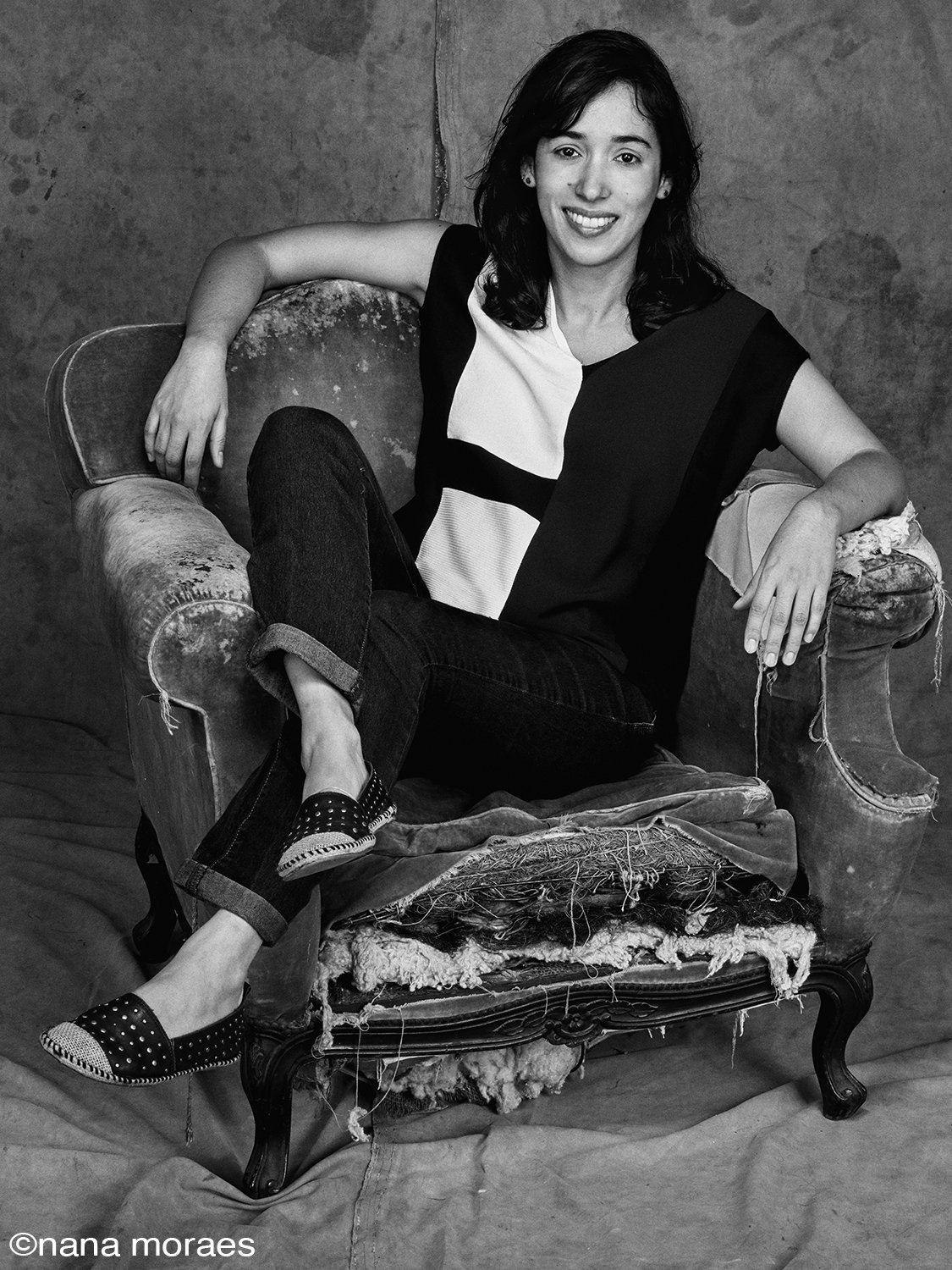
interview
ioana mello
curator, photo editor
brazil
How do you define your role in the photography world?
To be a bridge — that is my role. A bridge between artists and institutions, between artists and the public, and also between different perspectives and cultures, as my work often moves between Europe and Latin America. A bridge between artworks, since I deeply enjoy working on group exhibitions, which allow me to bring diverse visions and artistic practices into dialogue. I also see myself as a bridge between art and the pressing themes of our contemporary society and the human condition. Beyond that, I aim to be an instigator: someone who provokes, who challenges predictability and the obvious — in others as well as in myself.
Why do you do what you do?
That’s a good question. Curatorial work can often feel thankless: it is frequently invisible, overlooked, and marked by precarious conditions. It is also widely misunderstood. Today, the title of “curator” has been popularized to the point of being applied to everything from Instagram feeds to music playlists, travel itineraries, menus, or lifestyle experiences — as though any act of selection and arrangement were the same as curating. In my view, this reflects a broader cultural phenomenon which has diluted the specificity of curatorial practice.
And yet, I remain committed to this path because it brings together some of my deepest passions: art, politics, people, and image theory. It is at this intersection that I find true meaning in what I do. And I often do a pretty good job!
Where do you look at photographic work? How do you discover new artists?
Everywhere. Portfolio reviews, awards, residencies, festivals, Instagram, word of mouth, exhibitions… the discovery of new artists happen on a daily basis. I am also fortunate to circulate widely, moving between Paris — a major hub of photography — and numerous festivals across Latin America. This constant movement brings me into contact with countless images and series. More recently, I joined Fetart, a collective of independent women curators specialized in emerging photography, which has further expanded this horizon: we continuously exchange ideas, share discoveries, and introduce each other to works that might resonate. The power to be and work with collectives.
What is the most significant challenge facing contemporary photography today, and what is the greatest opportunity?
From my experience, several challenges stand out. One of the most pressing is how to move beyond the entre-soi and bring photography outside of its own circle of specialists. This connects directly to a broader issue: the democratization of photography. Although we all carry cameras in our pockets, through our phones, the ability to truly read, understand, and critically engage with photography and visual culture remains a privilege for only a few.
That is why, working within the photography world, I am committed to making the medium more accessible — through projects that break away from the white cube, that attract diverse audiences, and that prioritize mediation. A meaningful example is the Biennale de la Photographie in French Guiana – les Rencontres Photograhiques de Guyane - where I served as associate curator for two years. The event’s mediation team does, with Oceane Larsonneur as director of mediation and Karl Joseph as its artistic director, extraordinary work engaging children and the wider public, fostering continuous dialogue. This creates a deeper exchange between artists, curators, organizers, and audiences. For me, it is precisely within such challenges that new opportunities are born.
I must also highlight the role of technology, particularly artificial intelligence. AI embodies both a profound challenge and an extraordinary opportunity. It reshapes the very notion of the image, while opening new avenues for dissemination, dialogue, and visual education. Technology has made it significantly easier to connect with artists from Latin America and beyond, fostering collaborations that would have been far more difficult a decade ago. At the same time, we are witnessing fascinating artistic practices that integrate AI in thoughtful and critical ways — for example, the work of the Martinican artist Jordan Beal or the Mexican photographer Cristóbal Ascencio, among others.
Another challenge I must mention is the inclusion of women photographers in the market. While there has been some progress over the past five years, there is still much work to be done. In this regard, I collaborate with the Venezuelan artist Oleñka Carrasco through an association, La.Ima., that takes concrete actions and offers mentoring, helping more artists from underrepresented communities to connect and enter the market. I’m also a member of “Les Filles de la Photo” that helps, in France, to make the work of women photographers visible, work that might otherwise be marginalized or less recognized.
These artists are often those coming from regions with smaller or less developed markets, women whose visibility remains limited, or those working with series and approaches that are less readily accepted by the mainstream art market. Supporting them is both a challenge and an essential responsibility in shaping a more inclusive photographic landscape.
When you look at the current state of photography, what, if anything, do you feel is missing from the conversation and the work being produced?
What I often find missing in the current state of photography is a deeper engagement with context and meaning. We live in an age saturated with images — everyone produces and consumes them daily — yet critical conversations about how we read, understand, and question images are still restricted to relatively small circles. I believe there needs to be more space for dialogue that connects photography to our everyday issues: politics, ecology, identity, migration, and the urgent challenges of our time.
I also feel that voices from outside the dominant centers of the art world are still not heard enough. Photography is a global practice, yet the visibility of artists from the Global South — and especially women and underrepresented communities — remains uneven. Expanding these perspectives is not only a matter of justice, but also what will keep photography relevant and alive.
Crucially, however, this must be done in a respectful and decolonial way — one that acknowledges the histories behind each body of work and the cultural background of the countries in question. Too often, these narratives are approached through lenses of exoticism or treated as fleeting trends. What we need instead is sustained, thoughtful engagement that fosters genuine dialogue and long-term understanding.
What advice would you offer to an “emerging” photographer who wants to get their work noticed?
My main advice is to take part in as many portfolio reviews as possible — always with a well-structured portfolio and a thoughtful presentation. Equally important is to immerse yourself in the photographic spaces around you: galleries, festivals, artists’ studios. It is within these environments, in the buzz of people and events, that work is seen, discussed, and remembered. Again: the power of a community, to work collectively.
Another key point is to keep an updated online presence with your most recent work. I know it’s not always easy — we often lack the time or resources to regularly update our websites or Instagram — but it truly makes a difference.
And above all, be patient: recognition rarely comes overnight. There are artists I’ve wanted to collaborate with for years, and yet the right project has not yet materialized. A career is built through encounters and timing — and it is along this path that meaningful connections take shape.
The art world is less centered on traditional hubs like New York or London. How impactful is this decentralization? From your perspective, what are the primary opportunities and challenges for Latin American photography and photographers in today’s international market?
The decentralization of the art world has had a noticeable impact, though it remains limited. It has opened new platforms and opportunities beyond traditional centers like New York or London, allowing different narratives and geographies to gain visibility. Yet these hubs still largely set the rules of the game. For Latin American photography, however, this shift is crucial: it offers artists the chance to be seen and engaged with on their own terms, while also strengthening connections across the Global South and with Europe, Africa, and Asia.
The opportunities are many: greater visibility for local ecosystems, the emergence of new curatorial voices, and audiences that are increasingly curious about diverse ways of seeing and representing the world. But there are also important challenges. The infrastructures and resources available in Latin America are still uneven compared to those in the North. Too often, Latin American photography is approached through the lens of exoticism or as a temporary trend, rather than through sustained engagement with the histories and contexts that shape the work.
From my perspective, the task is to turn decentralization into a real redistribution of visibility and value. That means building collective initiatives, fostering long-term collaborations, and insisting on decolonial approaches that respect the cultural backgrounds and specificities of each artist. Only then will decentralization become more than a geographical shift — it will become a genuine transformation in how we understand and value photography globally.
How is the work of curators like you shaping the international perception and value of Latin American photography?
I find it difficult to think of myself as working alone. The real strength lies in being surrounded by many people with whom I collaborate to ensure that Latin American photography travels, gains recognition, is studied, and sparks meaningful dialogue. My secret is, above all, the collective.
It’s not easy. We are taught, both in school and culturally, to work in isolation—the creative solitude of artists—and to fear our peers, since the market is small and competition is high. Breaking away from these stigmas is easier in theory than in practice. Yet in my experience, the more I open up to others, the more we all benefit. My success is intimately tied to the success of every Latin American artist and to each remarkable curatorial project.
At the same time, I carry with me the drive to share stories and perspectives, struggles and resistances, while embedding them in their proper contexts — in order to avoid both exoticism and oversimplification. What guides me is the desire to reveal how much closer we are in our shared humanity than we often imagine.
Are there particular visual styles, themes, or approaches that you believe are central to contemporary Latin American photography?
Photography in Latin America is multifaceted: it encompasses many strands, histories, and contexts. Our countries are diverse, and this diversity unfolds into a wide range of themes — which is why it would be a mistake to reduce it all to a single label. Still, we share a common past, shaped by social and political histories that create points of recognition across the region.
Within this convergence, I would highlight the pursuit of social justice, the engagement with colonial histories, and the embrace of decolonial perspectives as defining elements. There is also a radical creativity that arises from the need to overcome the precarious conditions under which art is often produced in our countries — and it is precisely from this resilience that much of the originality of contemporary Latin American photography emerges.
Can you name some projects by “emerging” photographers that have recently captured your attention? What made the work stand out to you?
Do you have the time — and an extra page in this edition? Because what I comes across most often are works that truly capture my attention. There is SO much exciting work being produced, and I know I’ll inevitably forget some names I’ll regret later.
From Brazil, I recently curated a wonderful exhibition about Carnaval in 2025 during the France-Brazil season in French Guiana, featuring 12 remarkable artists whose works were strong, diverse, and rich in language. Among them: Bruno Zorzal, Shinji Nagabe, Shai Andrade, Régis Amora, Moara Tupinambá, José Roberto Bassul, and Ian Cheibub. Beyond this exhibition, I would also mention Daniela Balestrin, José Diniz, Marilene Ribeiro and Ricardo Tokugawa.
I’m also captivated by the new wave of Bolivian photography, with young artists moving away from classical documentary traditions to explore new paths — such as River Claure, Marisol Méndez, Wara Vargas, and Daniel Mebarek, to name just a few.
From Venezuela, I would highlight the powerful Oleñka Carrasco and Fabíola Ferreiro; from Peru, Alejandra Orosco Venero; from Argentina, Maximiliano Tineo, from Equador Isadora Romero, there are so many...
In Europe, I’ve been discovering a fascinating scene in Eastern Europe, full of singular artistic universes. There’s also the Italian artists Nicola Lo Calzo and Davide Degano, both of whom I met at the Guiana festival. And finally, from the Caribbean, extraordinary talents such as Jordan Beal, Nathyfa Michel, Anaïs Cheleux, Wendie Zahibo, T2i, and NouN.
It’s a tough and, in some ways, unfair question — because I’ll surely leave someone out and regret it afterward!
If you could own one photographic image and price and availability were not an issue, what would it be?
There are two artists I deeply admire and would love to have at home as a constant source of both theoretical and human inspiration. One is the Japanese photographer Hiroshi Sugimoto, particularly a piece from his Theater series. His work inspired me during my Master’s studies, sparking my desire to delve into theories of the image. I find his practice truly extraordinary.
The other is the Mexican photographer, Graciela Iturbide. The power of her dialogue, her struggle, and her worldview make her an undeniable reference — always an inspiration to me.
Anything you would like to add?
I would also like to mention some curators who inspire me and who currently support my work. There are many, but here I highlight those with whom I have had the chance to exchange more closely, and whose ideas and trajectories have deeply inspired me for one reason or another: the Brazilian Márcia Mello, French curators Emmanuelle Halkin and Marie Guillemin, the Belgian Estelle Lacaille, the Indian Tanvi Mishra, the Portuguese Angela Berlinde and the Italian Elisa Medde.
Thank you. It was a pleasure to dive a little bit into my practice.
Ioana Mello, originally from Brazil, works between Europe and Latin America, collaborating with institutions, galleries, collectives, and festivals such as Ithaque, Photodays, Les Filles de la Photo, Iandé, Fondation MRO, Foto em Pauta, and Les Rencontres d’Arles. She is one of the three artistic directors of the FotoRio festival in Brazil, associate curator of the Rencontres Photographiques de Guyane 2024/25, and a member of Fetart, the collective behind the artistic direction of the Circulation(s) Festival in Paris. Her practice includes organizing residencies and training programs, writing on photography, and serving on international juries such as Portrait of Humanity, British Journal of Photography 2024, and Sony World 2023. Based in Paris, she is also part of La.Ima., an international laboratory for image transmission and creation.
News:
- Biennial: Les Rencontres Photographiques de Guyane at Maison de la Photographie (MAZ) in Rémire-Montjoly, Cayenne, Kourou & St Laurent-du-Maroni, French Guiana - November 26, 2025 - January, 25, 2026
-Festival: Circulation(s) - Festival de la jeune photographie en Europe at Le Cent-Quatre-Paris in Paris, France
March 21 - May, 26, 2026