
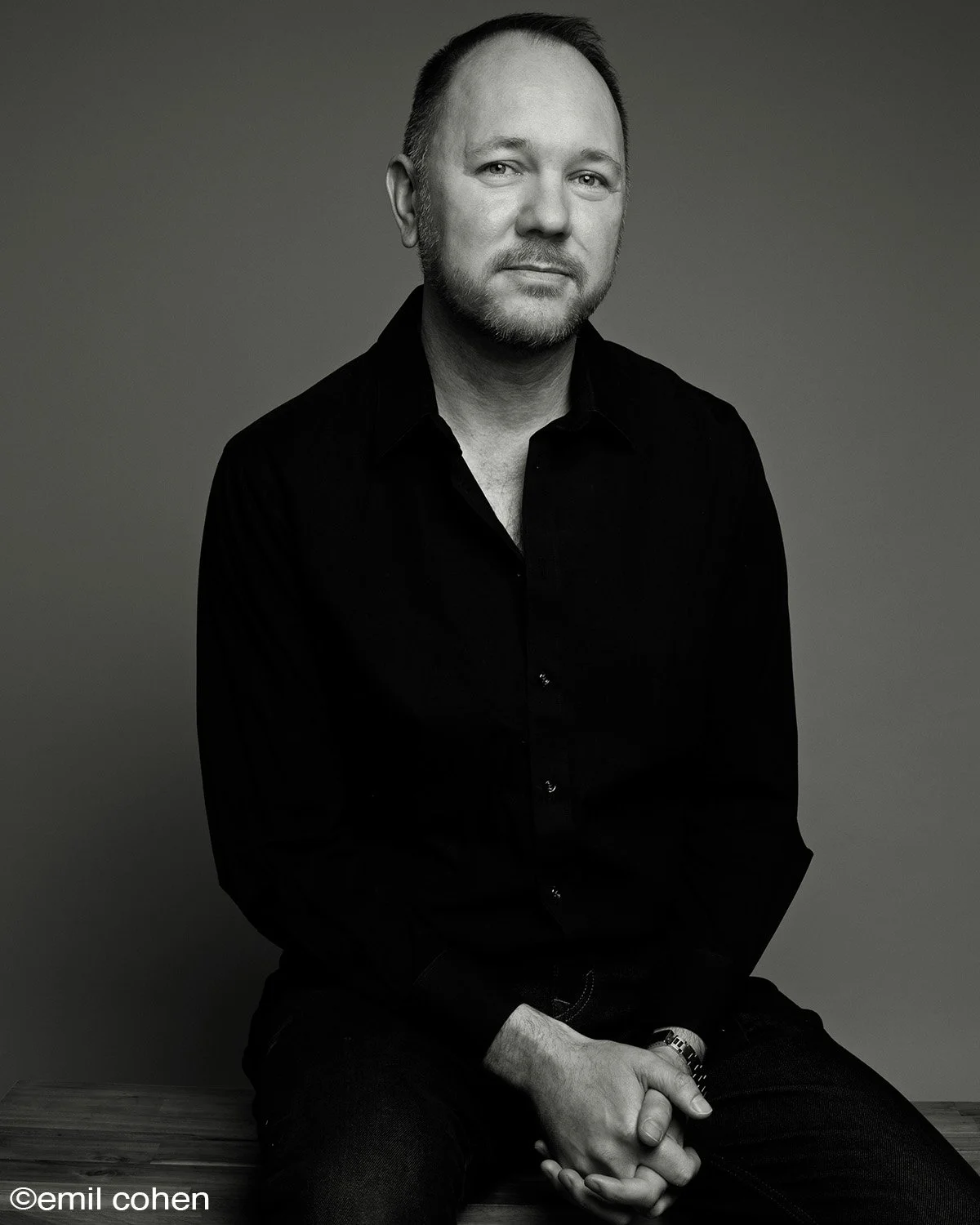
interview
brian paul clamp
gallerist / clamp gallery
new york, usa
How do you define your role in the photography world?
I am a gallerist, meaning that I own a business exhibiting and representing artists and estates, and I sell artwork to private collectors, consultants, advisors, corporate collections, and museums. Aside from placing artworks, my role includes providing direction to artists on a variety of matters, as necessary, in addition to offering advice and guidance to clients on a wide range of matters. I also curate exhibitions (most often at my own space), which are often the first display of artworks coming out of my artists’ studios.
Why do you do what you do?
I found my way to art dealing via my own photography practice and an academic pursuit of art history. Obviously dealing in art is a means to earn a living, but despite a lot of pressure and formidable responsibility, it is more personally meaningful and fulfilling than other job paths I could have pursued. My role as a culture maker is an important one, and I take my obligations seriously. I hope that my work and decisions have some sort of impact in the long term.
Where do you look at photographic work?
I find new work in many places, including artists’ websites, Instagram, magazines (both printed and online), monographs and other books, non-profit spaces, galleries, museums, and private collections. Artists, employees, colleagues, clients, and curators consistently introduce me to new work as well. I also participate in portfolio review events, and discover work there, in addition to private portfolio reviews at my own gallery.
What is the most significant challenge facing contemporary photography today, and what is the greatest opportunity?
I think there has been a significant shift in the last twenty years in the way in which our culture thinks about, interacts with, and appreciates photography. This is due in large part to smart phones and social media. We are challenged by the fact that now everyone is a photographer. Perhaps ironically, the greatest opportunity is also social media in that it opens up the world as a potential audience. An individual artist’s reach is greater than ever before, and with this opportunity, many of the old gateways are being challenged.
When you look at the current state of photography, what, if anything, do you feel is missing from the conversation and the work being produced?
Much of the strongest work being produced today is photography which acknowledges its own materiality and the history of the medium. The integrity of artists employing analogue processes and darkroom development often overshadows a lot of photographers I see haphazardly shooting ephemeral and forgettable imagery rather than thinking about the production of art objects.
What advice would you offer to an “emerging” photographer who wants to get their work noticed by a gallery?
First develop a fully realized body of work. Photographers can present work to a gallery in hopes of obtaining advice or direction. But if you are hoping to exhibit and sell your work, start with your best foot forward and present a refined and coherent series of photographs which a dealer can consider in terms of a packaged exhibition. Present the work clearly and attractively on your website, and have some sort of social media presence established. Then, the task of getting the work in front of the gallery’s decision makers entails a variety of strategies. Some galleries still have open portfolio review guidelines, but if they do not, an artist must find someone who might provide an introduction (such as another artist from the roster, a client of the gallery’s, a curator, a critic, etc.). Perhaps the gallery sends its owner or staff to portfolio review events, or they jury shows for various organizations. Also attending exhibition openings, artist talks, and other events at a gallery where an artist can meet the staff and get to know them on a friendly basis can also be advantageous.
As an expert who has spent a lot of time with photography, what core elements do you look for in a photographer's work that signal long-term potential or gallery representation?
First and foremost the work must interest and excite me personally. I also want to engage with an artist who can speak intelligently about their work and understands how it fits into the broader story of contemporary art and art history. I am also looking for an impressively crafted object, i.e. a beautiful print. Further, knowing what an artist is considering for future projects is important, as it reassures me of their commitment to their craft.
New York City played a pioneering role in establishing the international contemporary photography market: How has the taste in photographic art changed and in your opinion, does New York still lead and what kind of work are people looking for in New York now?
There is no arguing that New York is still the center of the art world in the United States, and that includes photography. Nonetheless, there are now many other important and influential hubs including Los Angeles, Houston, Chicago, Atlanta, etc.—not to mention all of the vital cities across the globe. In New York, there is sadly a waning interest from collectors in classic 20th-century black-and-white photography. Many of the important collectors of this material are now passing away, and there is not a robust collecting audience replacing them. Just as we see in the wider art market, much more interest goes to contemporary work. In addition to solid investments, collectors today who buy photography are looking for unique prints or works from very small editions. Inclusivity and diversity have been among some of the defining features of emerging photographers and work in recent years, but this now feels challenged by the new political reality of 2025.
As one of the few important photography dominant galleries in New York can you tell us how you feel about the future of contemporary photography both in New York specifically and globally?
I am concerned about the future of contemporary photography. Photography, like painterly portraiture or figurative art, abstraction or performance practices has historically drifted in and out of fashion. However, the last wide pendulum swing to the right for photography was around the turn of 21st century when large color prints were in vogue (think Andreas Gursky, Thomas Struth, Cindy Sherman, Jeff Wall, etc.). Not only were photographs by these artists sought by collectors of the medium, connoisseurs of contemporary art in general understood the importance of including works by these figures in their art collections. We need a new generation of artists utilizing lens-based technologies who are as much part of today's conversation of contemporary art as their peers working with other media. However, as I stated earlier, the public’s understanding of and appreciation for the photograph has significantly shifted in the last quarter of a century. The challenge is how photographers can recapture the fascination and high regard of art audiences while building upon and advancing the achievements of their predecessors.
Has the traditional gallery system's role in 'discovering' talent been fundamentally disrupted, and if so, what new models of validation and career-building are emerging?
Yes, the gallery’s traditional role in discovering talent has been challenged significantly by social media. Many collectors endeavor to buy work directly from artist’s studios before they are endorsed by commercial gatekeepers. While this is an opportunity in one sense for emerging artists, it also can impede exhibition opportunities and relationship building within the gallery and museum world. Studio sales are not necessarily a badge of validation if they are won at the expense of being able to present work in a public setting. Gallery and museum exhibitions still represent essential career-building tools in contrast to pop up presentations, art fairs, and other short term displays.
A recent development in the art world involves galleries exhibiting work by artists without the commitment of representation. Many young artists are hesitant to tie their cart to one horse, but recognize the exigency of exhibition opportunities. Gallerists now see the advantages of one-off presentations of artists’ bodies of work without the monetary and time commitments which accompany involved contracts.
Can you name some projects by “emerging” photographers that have recently captured your attention? What made the work stand out to you?
“Emerging” has to be taken with a grain of salt, of course. But, in 2023, I was asked to serve as a juror for Lensculture’s Art Photography Awards. The panel of judges and I chose Ukrainian artist Vic Bakin as the 1st Place winner. His rough photographic portraits of queer youth in his home country printed on small scraps of silver paper are full of pathos and poetic wonder.
Ian Lewandowski’s ongoing photographic and publishing practice has fascinated me for many years now. Primarily a practitioner of large-format portraiture, Lewandowski is a sophisticated inheritor and author of queer history and visual culture. His project “The Colossus” was exhibited at CLAMP in 2024 and accompanied by a risograph catalogue printed by TXTbooks (Brooklyn)
Another large-format shooter, whose work is also well represented and distributed through printed publications, is Pia Paulina Guilmoth. She makes work addressing gender, ritual, class, beauty, and relationships to the land. Earlier in 2025, CLAMP exhibited “Flowers Drink the River,” a series which documents the first two years of the artist's gender transition while living in a rural, predominantly right-wing town in Maine. Haunting nocturnes reflect both beauty and terror in a world where queer existence can be at turns both euphoric and deeply perilous. The accompanying monograph of the same title from STANLEY/BARKER (London) was recently shortlisted for PhotoBook of the year by the Paris Photo/Aperture PhotoBook Awards.
If you could own one photographic image and price and availability were not an issue, what would it be?
There are really are so many possibilities, but I will go with “French Chris on the convertible, New York City” from 1979 by Nan Goldin. It is a contemporary “Pietà”—but instead of Jesus, the artist’s subject is a young man blackout drunk with an empty can of Schlitz nestled by his right ear; and instead of Mary, the supine figure is cradled by the open hood of a beat up blue automobile. Interestingly, over twenty years ago in the early years of my gallery, I did own a vintage print of this photograph. But, of course, to keep the lights on, I sold it to a well-known young actress who hopefully still cherishes what she chose to acquire.
Anything you would like to add?
Thank you for initiating this interview. At a societal moment of anxiety and deep uncertainty which is negatively affecting creative professionals of all stripes, it is important to reflect and consider what makes our lives richer, more meaningful, and worth navigating significant challenges.
Bio:
Gallerist Brian Paul Clamp has over thirty-five years of experience in the field. He holds a Master of Arts degree in Critical Studies in Modern Art from Columbia University, and is the author of more than forty articles and publications on American art to date.
Established in 2000, his gallery, CLAMP, is located in the Flower District in the Chelsea neighborhood of Manhattan. CLAMP represents a wide range of emerging and mid-career artists of all media with a specialization in photography. In addition, the gallery carries a large selection of modern and contemporary paintings, prints, and photographs from the early 20th century to the present. CLAMP has placed artwork in numerous important public collections.
News:
Exhibition:
Robert Calafiore - As My Eyes Open and You Disappear at CLAMP in New York, USA
through December 20, 2025
Exhibition:
Bill Armstrong - All a Blur at CLAMP in New York, USA in January and February
Book release:
Bill Armstrong - All a Blur: Photographs from the Infinity Series from ORO Editions
Exhibition: Arthur Tress - The Ramble, NYC 1969 at CLAMP in New York, USA
Book release:
Arthur Tress - The Ramble, NYC 1969 from STANLEY/BARKER
Also in January/February 2026, CLAMP will present “Arthur Tress | The Ramble, NYC 1969.” The show coincides with the release of the book of the same title from STANLEY/BARKER.