
claudia fuggetti and lara gilks
a visual dialogue
A Visual Dialogue in this issue between Claudia Fuggetti from Italy and Lara Gilks from New Zealand unfolds as a chromatic and atmospheric conversation, and together they create a hybrid reality where the boundary between the natural environment and human intervention dissolves.
visual alterations and perceptual shifts
Claudia:
Dear Lara
it’s lovely to meet you. I’m looking forward to working together.
For the dialogue, I’d like to work from visual alterations and perceptual shifts, using color, movement, and distortion as ways of questioning how reality is sensed and transformed. This connects closely with my current research.
I’m attaching my first image here as the opening gesture of our visual dialogue.
Lara:
Hi Claudia,
I am very excited to work with you also.
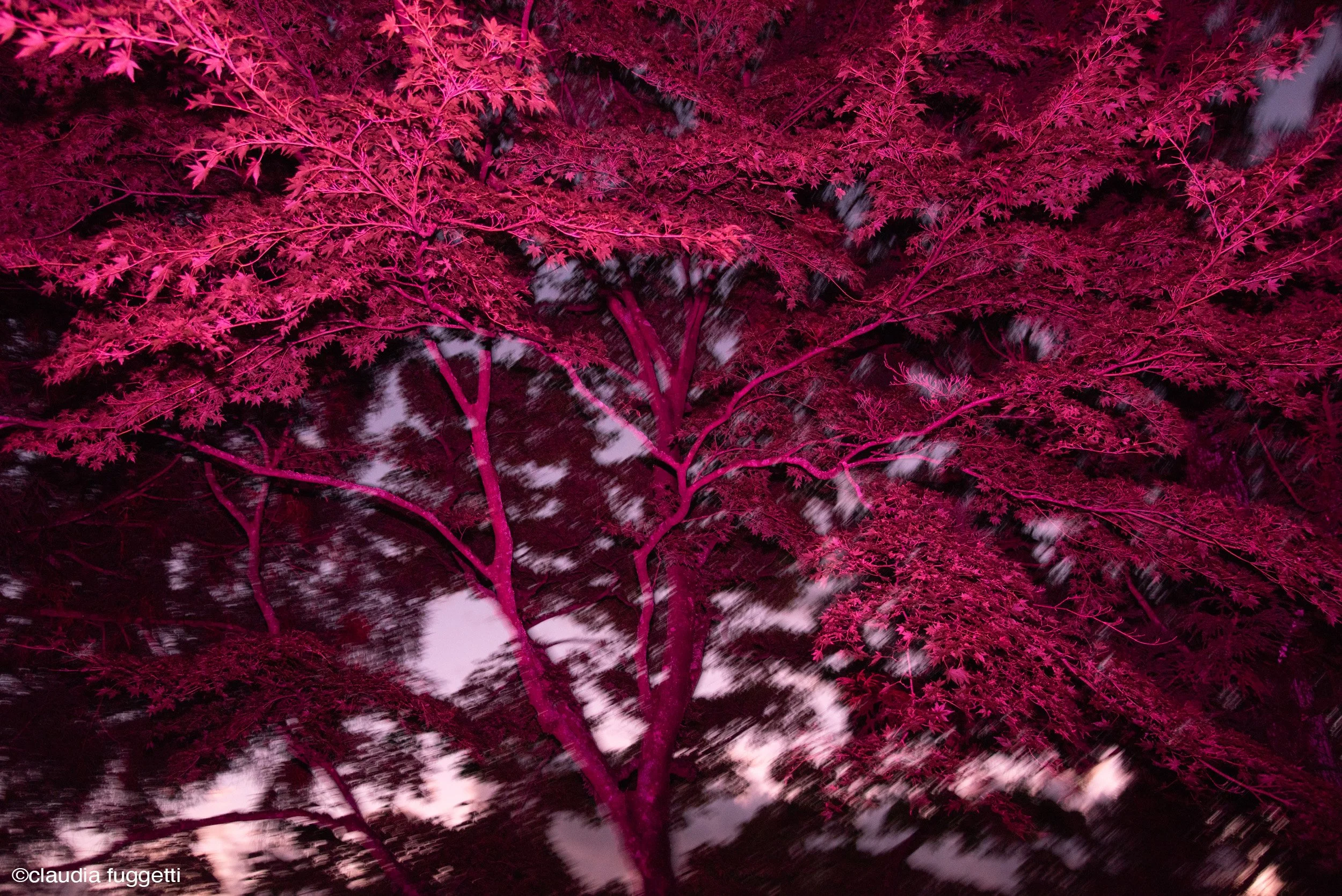
Your photograph feels strong and bold. The tree is recognisable with its branching structure and filtered sky still legible yet its colour dislocates it from the natural world. The saturated magenta does not describe light as it exists, it describes sensation and intervention. It begins to read as an internal landscape as much as an external one.
The slight blur further destabilises the image. The branches seem to vibrate as if the photograph is unable to fully settle into stillness, holding the viewer in a state of uncertainty.
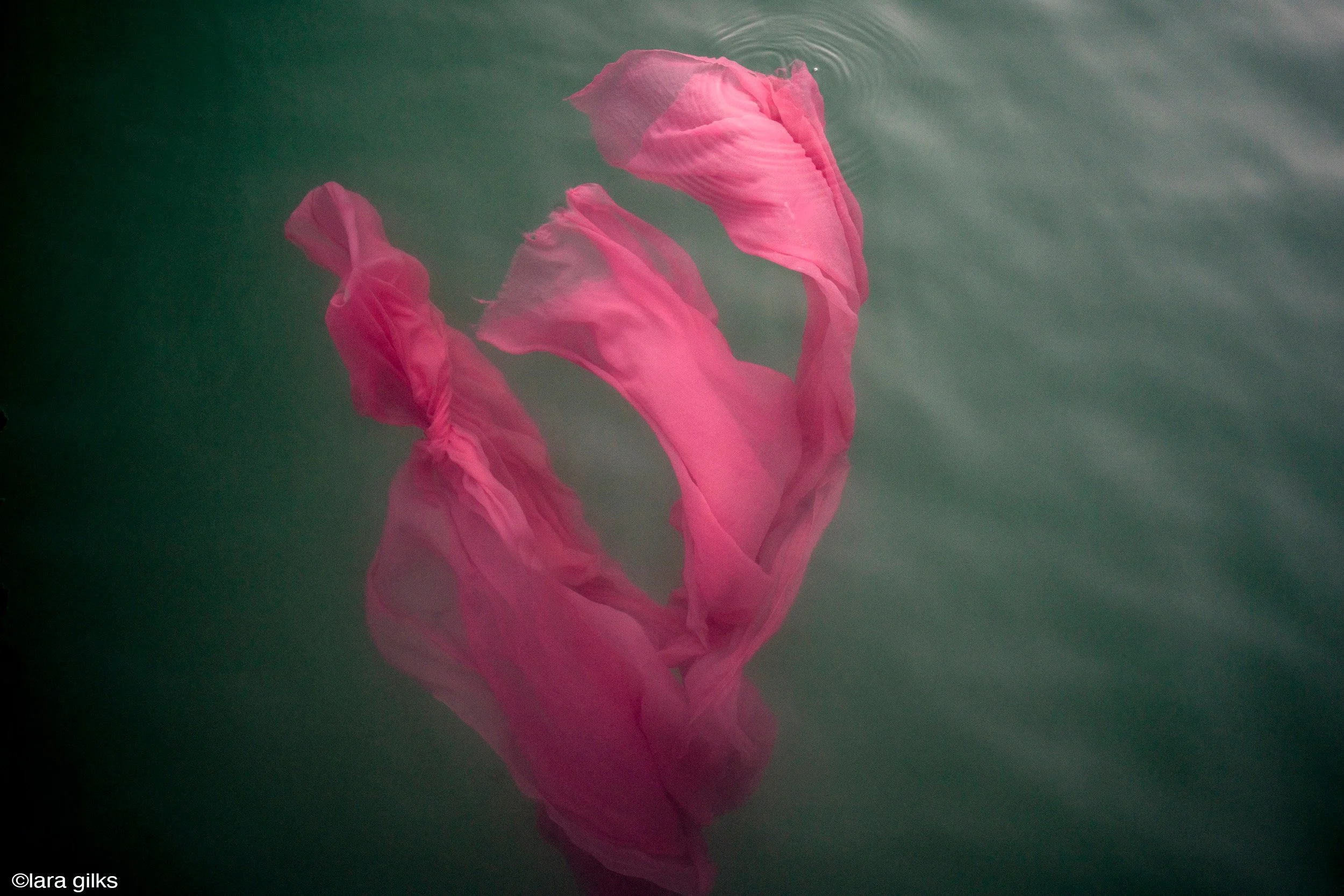
In response I have anchored your image and taken it to the ocean. I have re-situated your otherworldly tree within a different elemental context. As with your image my response feels unnatural and displaced from its origin yet something persists that is unmistakably familiar.
The surrounding green water acts as a counterpoint - being dense, opaque, and enveloping. Against it the pink becomes both intrusion and offering, resisting disappearance while remaining vulnerable to transformation.
This tension becomes the continuation of the dialogue - forest to sea; immersion to submersion; perception to transformation. Meaning does not disappear it shifts and it is unsettled and suspended between states.
I look forward to your second image and reply.
Claudia
Hi Lara
Thank you for your beautiful response, your image feels like a held breath.
The pink form drifts in dense green water as if it has been released from gravity, suspended between appearance and disappearance. It reads as something both intimate and elemental: soft, vulnerable, and yet strangely resilient. The ocean in your photograph isn’t a backdrop, it becomes a medium that slows time, blurs edges, and keeps the subject in a state of becoming.
What moves me most is the way the image refuses certainty. The form never fully settles into a single identity: it is cloth, petal, body, trace. It exists in that delicate interval where perception hesitates, where meaning is not fixed, but continually reshaped by the conditions of seeing.
This is where I feel our dialogue meets: in visual alteration as a way of speaking. Not distortion for its own sake, but a gentle destabilisation, a shift that opens the image into an inner climate.
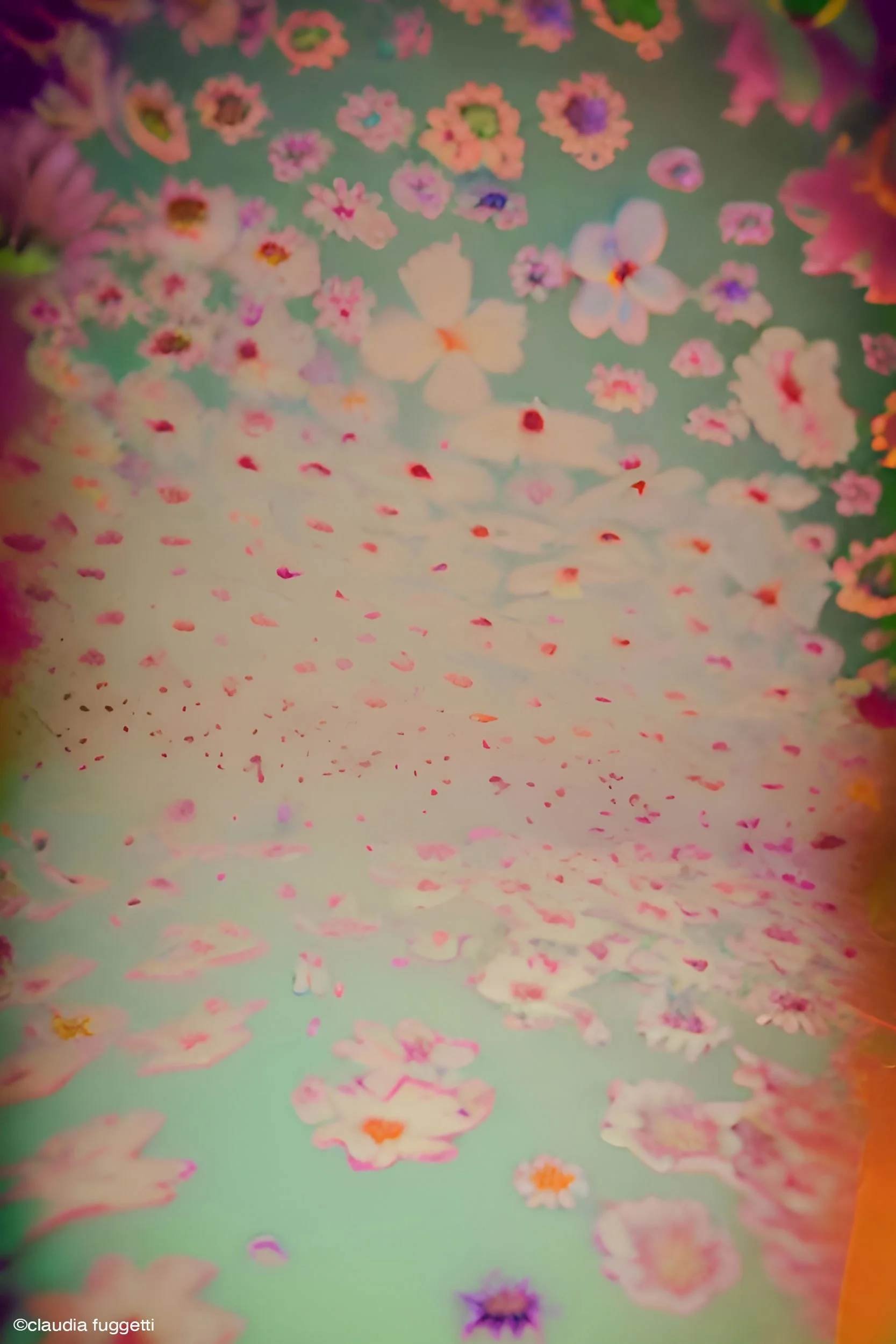
In response, I wanted to extend your sense of suspension into a different kind of space: an atmosphere rather than a location. My image presents a floating field, flowers dispersed like particles, drifting across a soft, milky plane. There is no clear horizon, no stable depth. Everything hovers between surface and immersion, between memory and material.
If your image holds a single presence suspended in water, mine widens into a suspended environment, a fragile perceptual space where forms dissolve into colour, light, and repetition. The world becomes less a place to describe than a sensation to enter.
I look forward to your next image and reply.
Lara:
I love your responding image particularly how the scale collapses and nothing feels anchored. The flowers dissolve their subjecthood to become mere particles and vision is asked to float. There is a beautiful calm to the atmosphere and your colour choices contribute to this softness. The image feels immersive and emotional, inviting a slow attentive way of seeing.
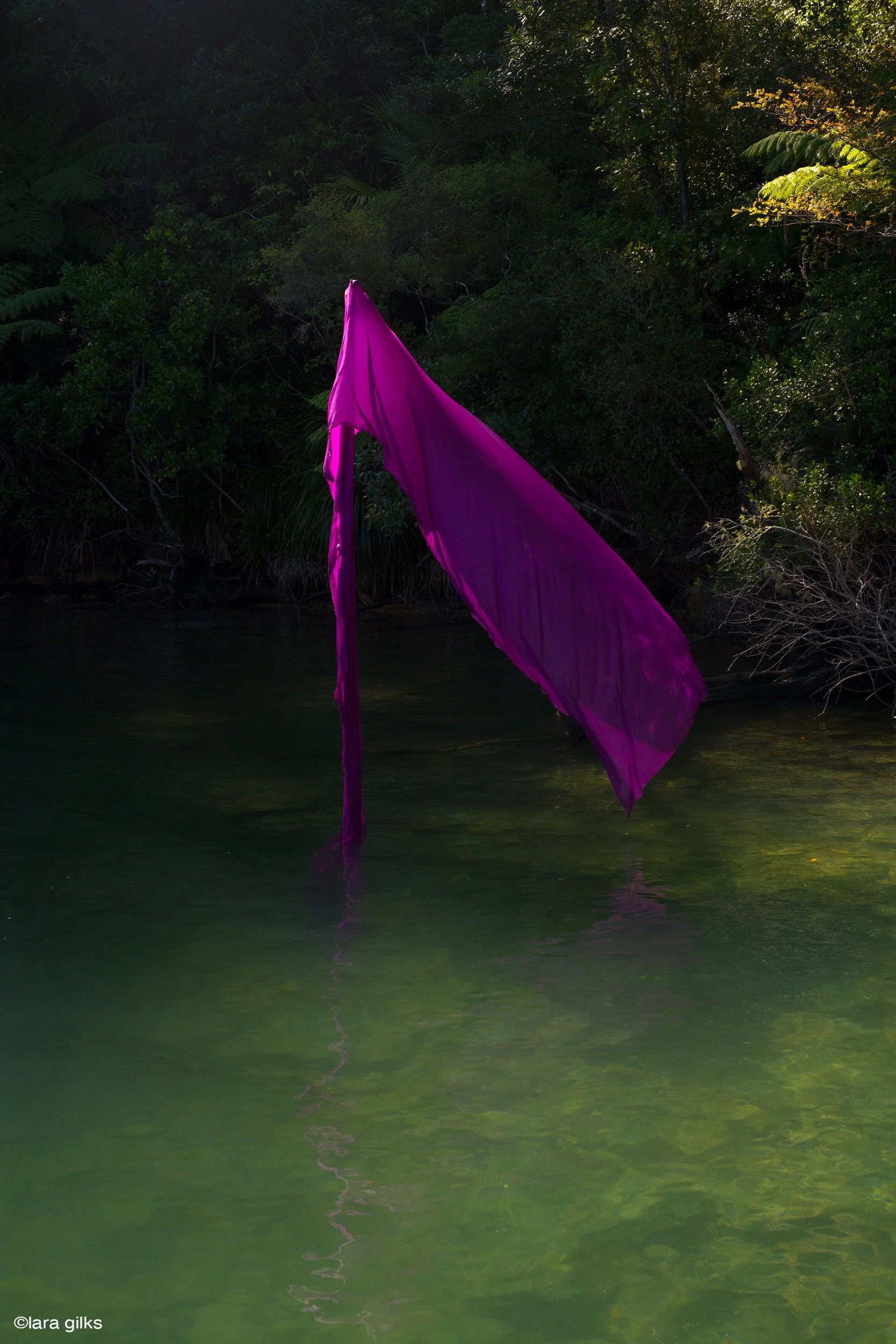
In response, my image gathers the diffusion in your image and places it in to a singular gesture. The magenta fabric wants to rise from the water and catch the light yet remains tethered. The fabric is anchored but lifted, it is suspended between gravity and release. The moment it holds is temporary and vulnerable. Both images hold their subject matter in a state of becoming - a drifting, a hovering. In different ways they ask the viewer to let go of control and enter a slower more attentive mode of looking. Both touch on a destabilised state that resists permanence, they hold a fragile moment in time.
Claudia:
Thank you for your generous reflection, I was deeply moved by how attentively you engaged with the images. I’m especially drawn to your use of magenta and the way light becomes almost theatrical in your last photograph. The colour feels charged, less descriptive than emotional, while the light holds the gesture in a moment of tension.
I feel very connected to this idea of letting go of control, particularly through shifts in perception.
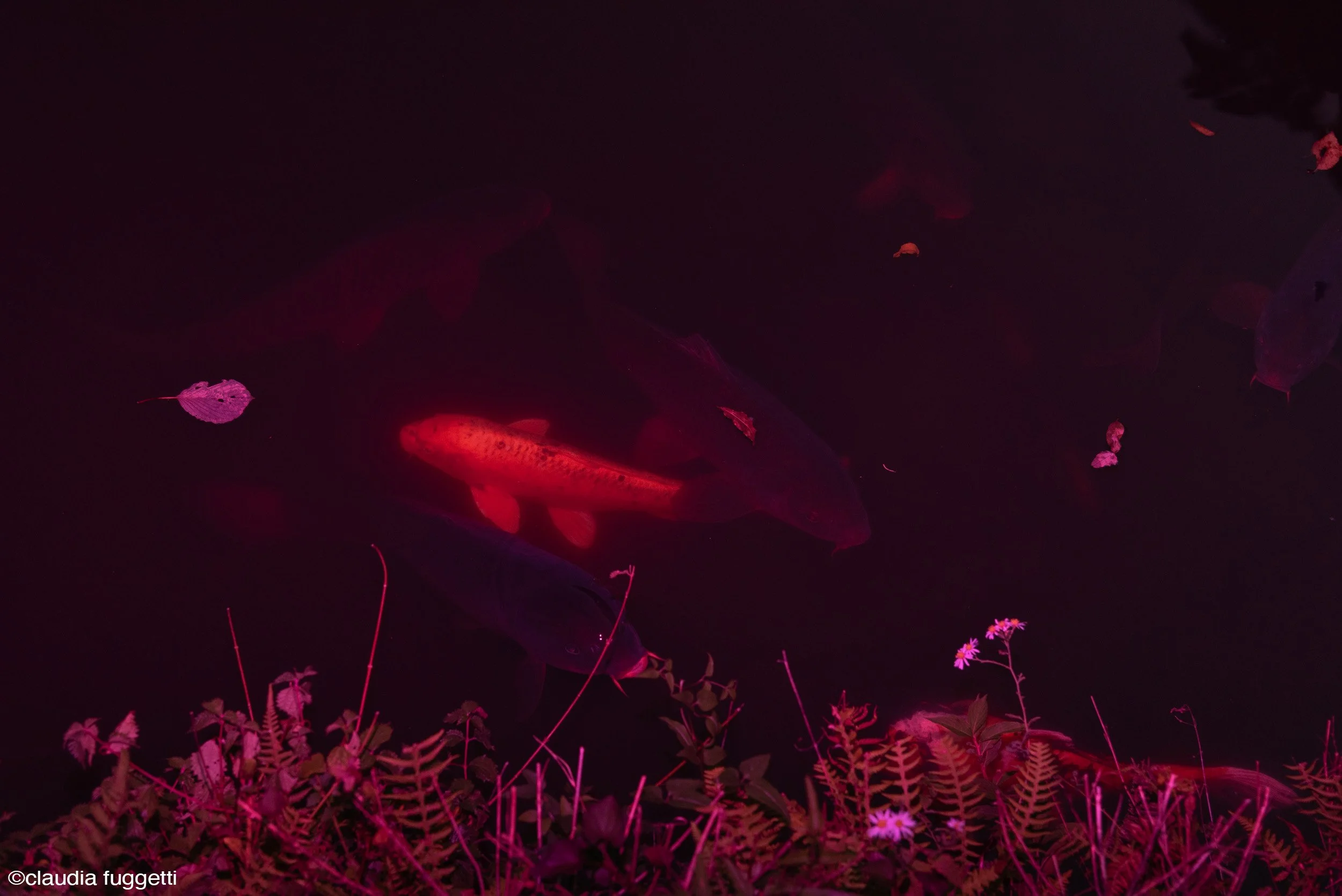
For this image, I wanted vision to remain unsettled. The fish surface and recede within the dark water, resisting fixation. There is no central subject, only drifting presences and fluctuating light.
Here, surrender becomes perceptual. The viewer is invited not to grasp the image, but to move with it, allowing colour, shadow, and movement to guide the experience. Seeing becomes less analytical and more intuitive.
In this way, the dialogue continues: through alteration rather than repetition, through perceptual shifts where forms soften, hierarchies dissolve, and meaning remains in motion.
Lara:
Your image has a powerful colour relationship, with red magenta light casting an unsettled atmospheric tone. The fish in darkness dissolving in to the shadow echo your earlier floral field image where the work similarly refused a central point of focus. My vision drifts continuously through your image searching for something to hold onto while remaining quietly unsettled.
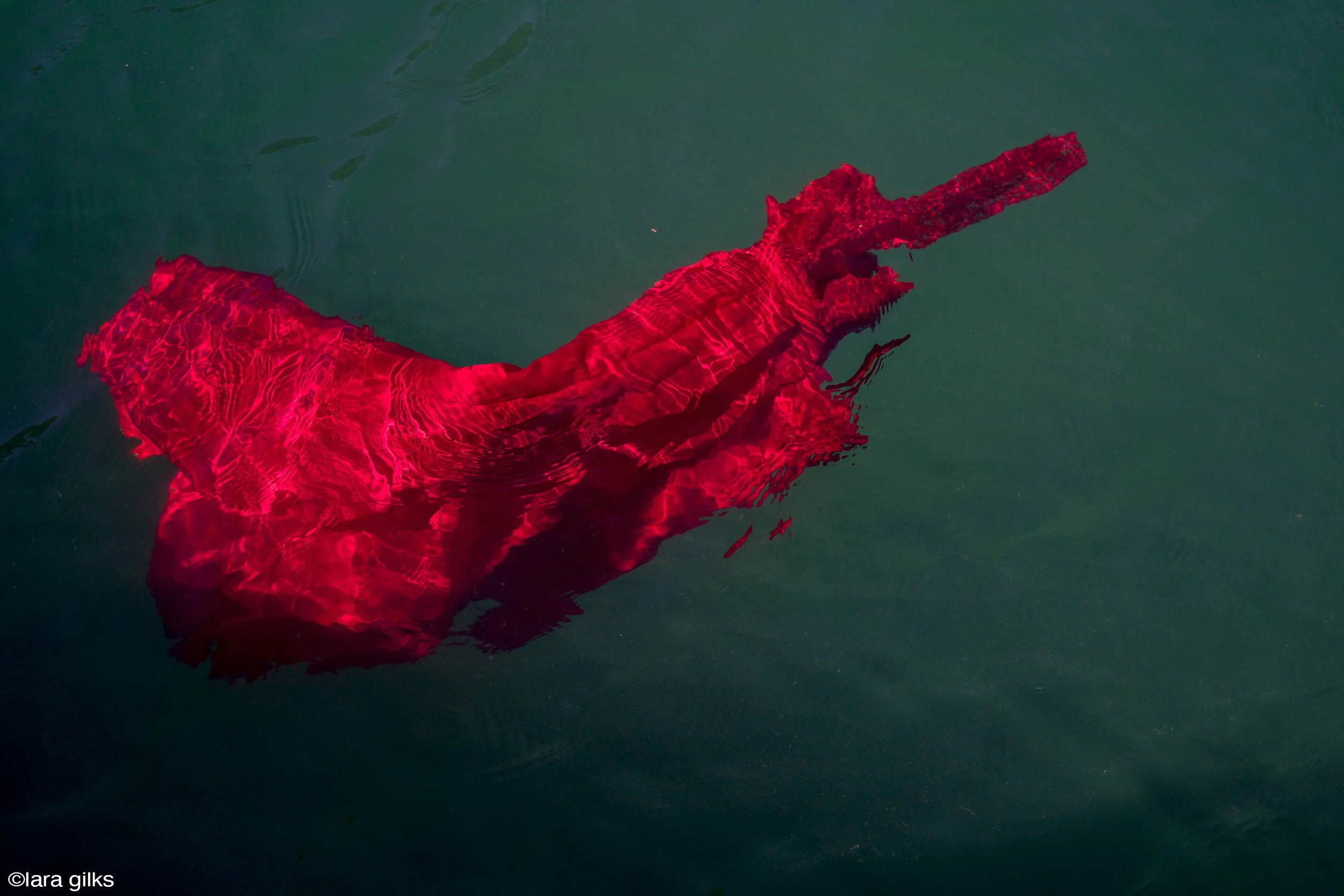
In response I wanted to extend our shared use of colour, the ocean, and your idea of drifting presence and fluctuating light. In my responding image the fabric is continuously shaped by water, light, and movement. I have allowed the water to take over.
We both use colour emotionally. The red is intense - your image glows within darkness while mine burns against green.
We both ask the viewer to move with the image rather than master it to linger within uncertainty rather than resolve it.
I feel our dialogue is now deeply interwoven, it is carried by drift, shadow, and light and unfolding as a shared attentiveness to fragility, transformation, and becoming.
Claudia:
Your last image holds a subtle tension between movement and restraint. The fabric appears continuously reshaped by water and light, never fully settling into a fixed form. What stays with me is how colour and reflection create a surface in flux — an image that seems to rewrite itself moment by moment.
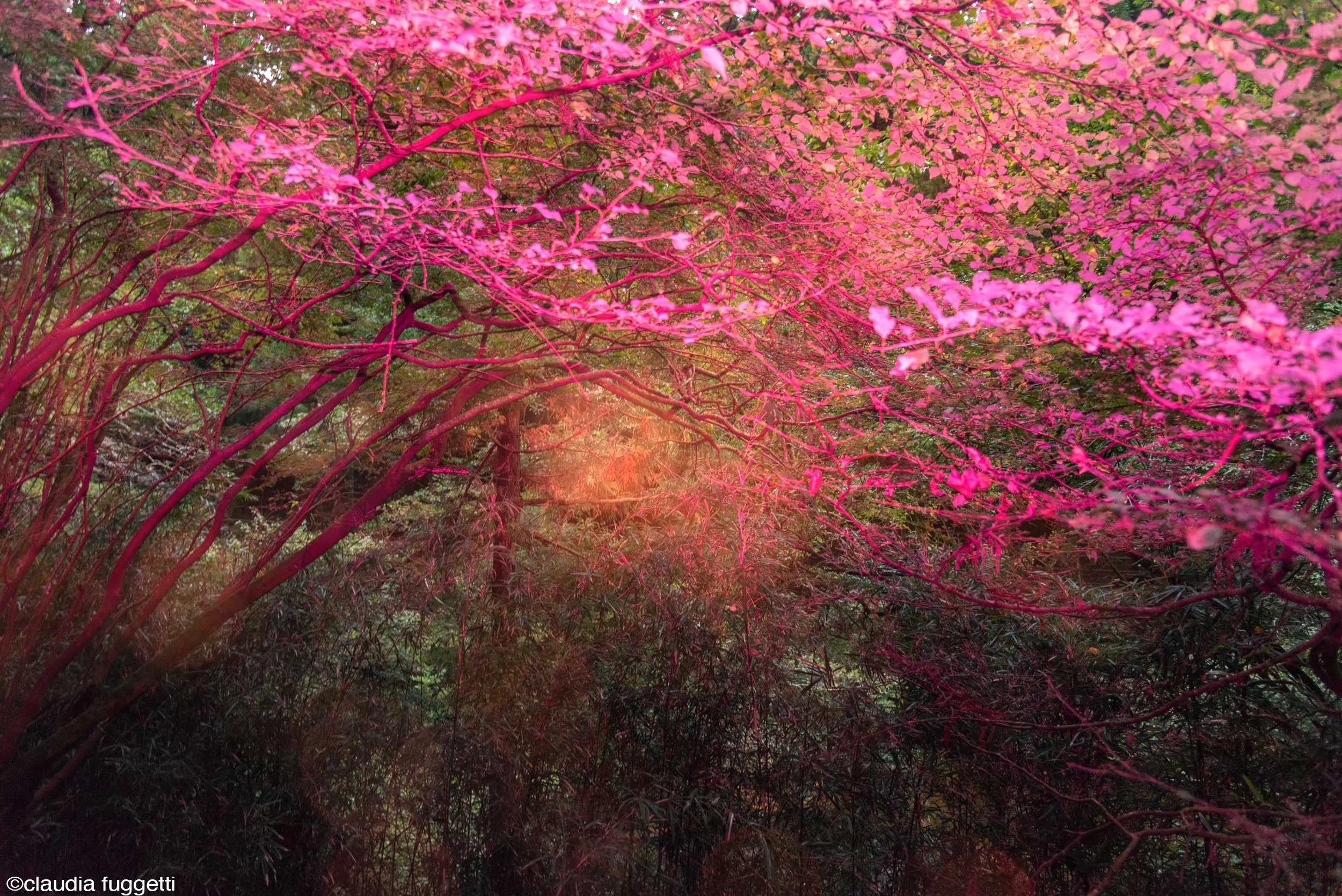
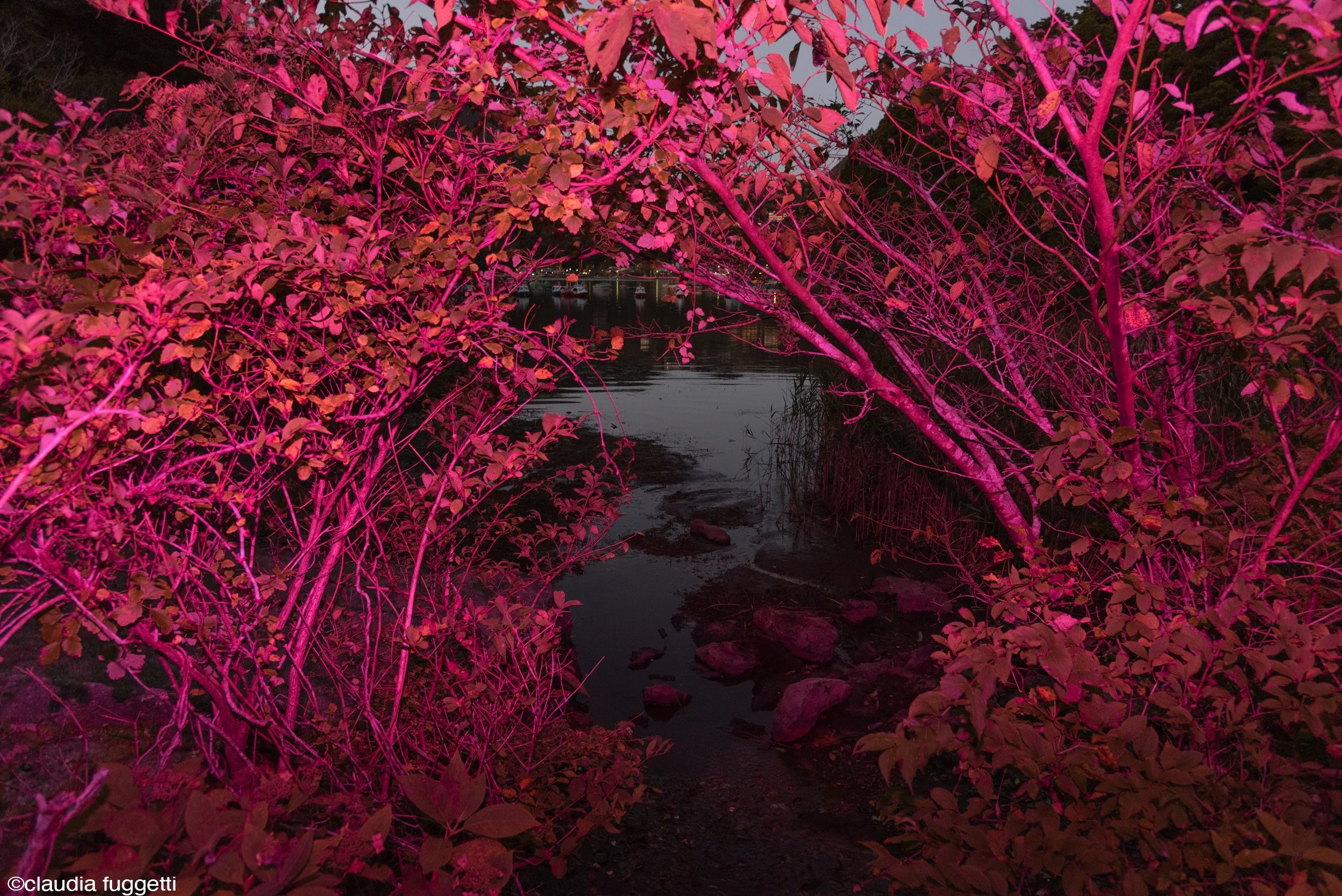
For my response, I returned to the forest, not as a place, but as a perceptual field. The magenta light alters the landscape, compressing space and softening structure. Colour becomes an active presence, shifting the image away from representation and toward sensation.
Here, light operates almost like a filter, opening the scene into visual uncertainty. What emerges is not a stable environment, but a space where perception recalibrates.
After water and movement, this feels like a quiet re-entry into altered terrain, another threshold where colour and light continue to shape how we see.
The dialogue keeps unfolding through these transitions, guided by attention and perceptual shift. I look forward to seeing your next image.
Lara:
Your forest image is incredibly beautiful. The colour is so active and it shifts the scene in to a pure visual sensation to almost take my breath away. The magenta light transforms the landscape from within compressing space and softening structure so that it feels less like a place and more like an experience.
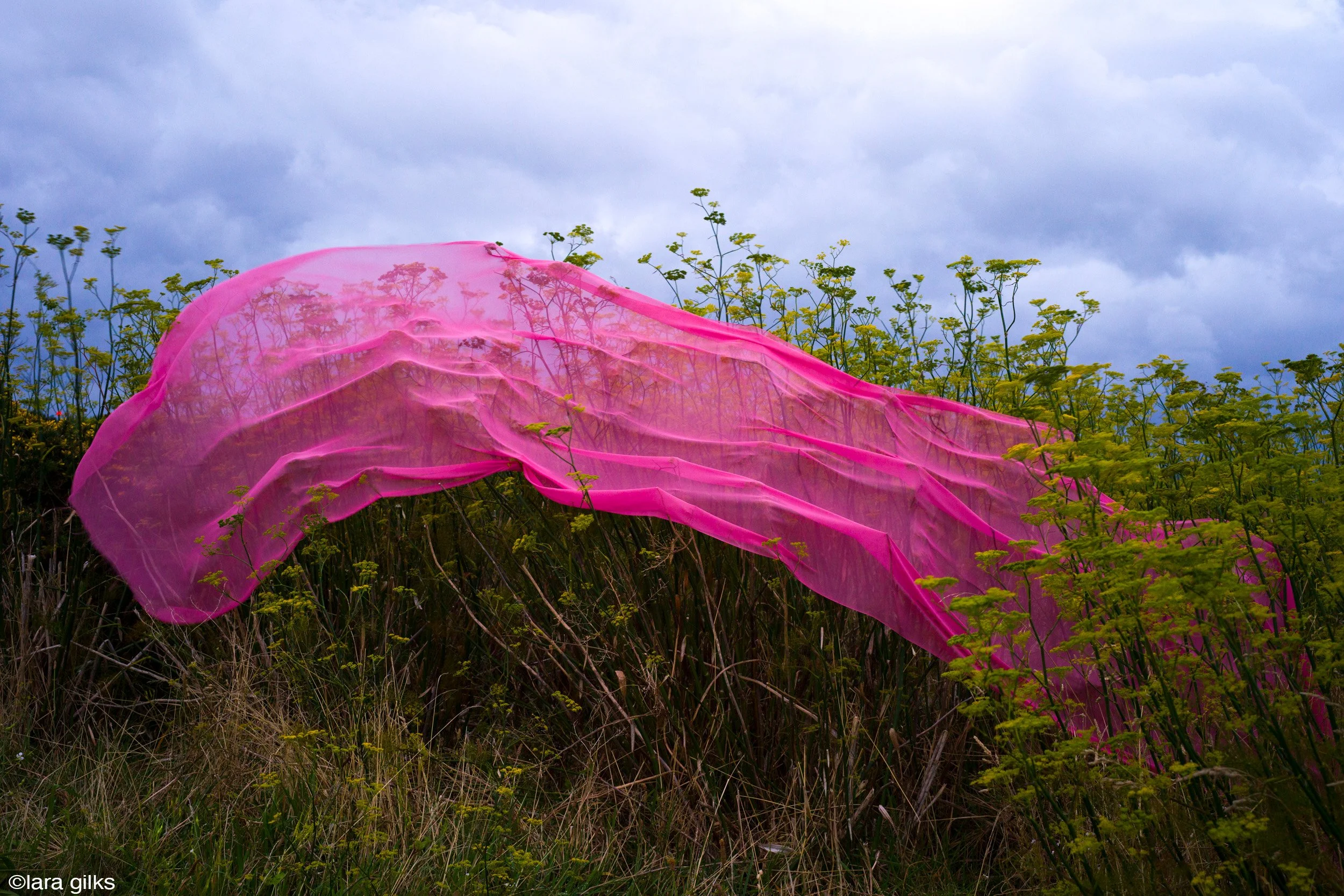
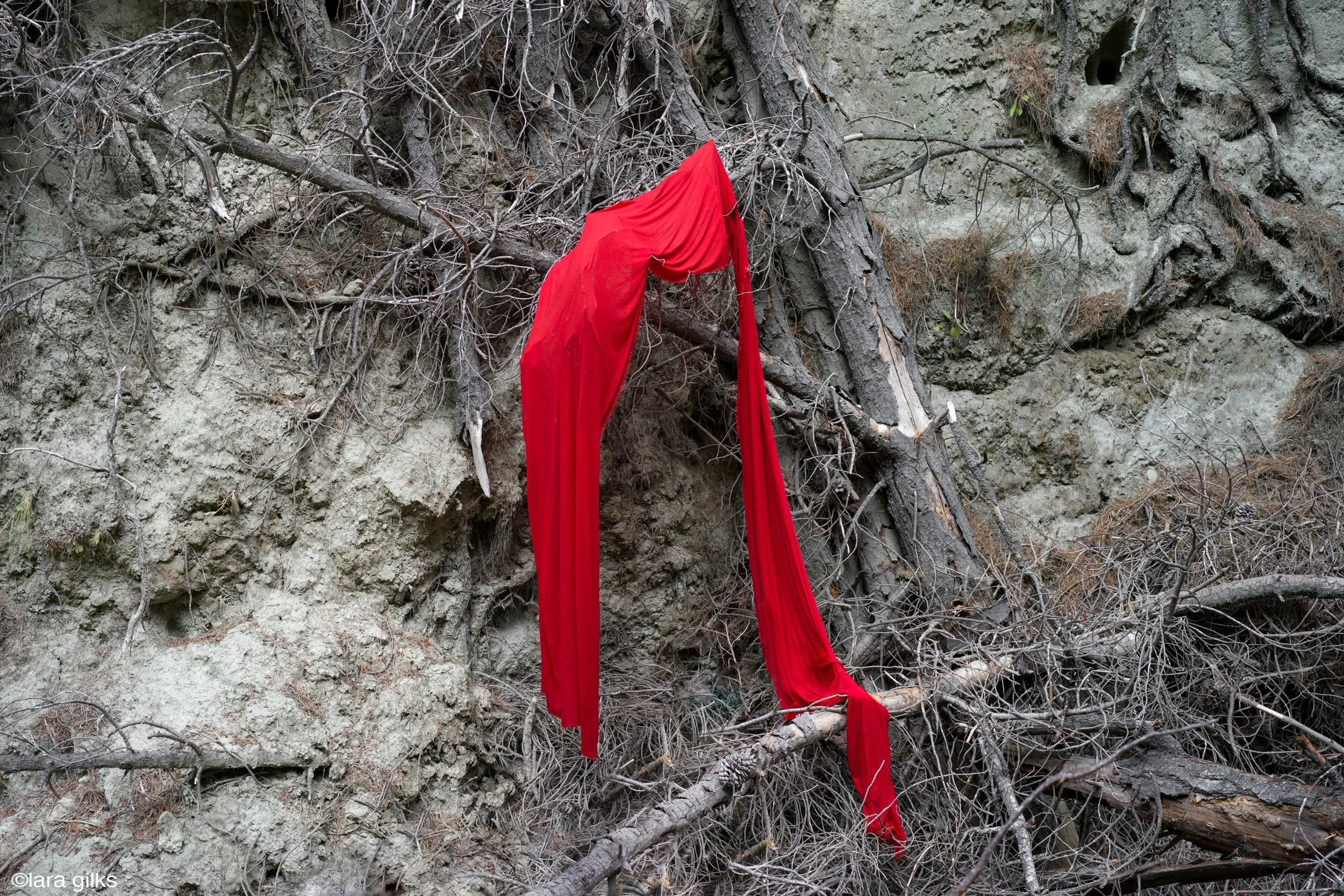
In response, I have brought my fabric back to the land and suspended it in the wind. Unlike the water the air gives it lift but it still has boundaries and is held in position by the bushes behind it. There is a subtle tension as it hovers between freedom and restraint.
The fabric filters the landscape altering how the viewer sees it. It does not fully conceal the terrain but mediates it - much like the magenta light in your image. Your image colour choice and the fabric in my image become active agents reshaping perception and transforming the environment into something felt rather than simply observed.
Claudia:
I really love the image you shared, it’s truly moving. I find it very ethereal: the fabric becomes a mediator between air, land, and light. It feels carried by the wind and at the same time held by the
landscape, creating a delicate tension between movement and containment. The material doesn’t simply occupy space; it gently reshapes it, inviting a perceptual shift.
My response is an image that functions as a portal, a passage between different states of perception, a return to water. I see it as an invitation to cross: from recognition to sensation, from external terrain to an inner atmosphere. Here, light acts as an intervention, opening a suspended threshold where perception recalibrates.
I feel our dialogue is now moving through these thresholds, guided by colour, mediation, and subtle transitions. Less a sequence of images, more a shared space of attention and transformation.
Lara:
The framing of your latest image is incredibly powerful - the opening toward the water draws the viewer inward through saturation and shadow. The space feels held as though perception must pass through a threshold, a portal as you described.
In response I have taken your idea of a portal and shifted the fabric into a more exposed terrain where it becomes entangled and restrained. The cloth feels heavy, almost wounded. The bright red against the pale and fractured cliff creates a stark and visceral contrast - the colour carries the intensity of blood. There is no softness of water here and no veil of air. The terrain is raw, skeletal and unforgiving. The fabric does not drift or filter, it confronts the land and is caught within it.
Claudia:
Thank you for taking the dialogue into such raw terrain, I felt the intensity of your image immediately.
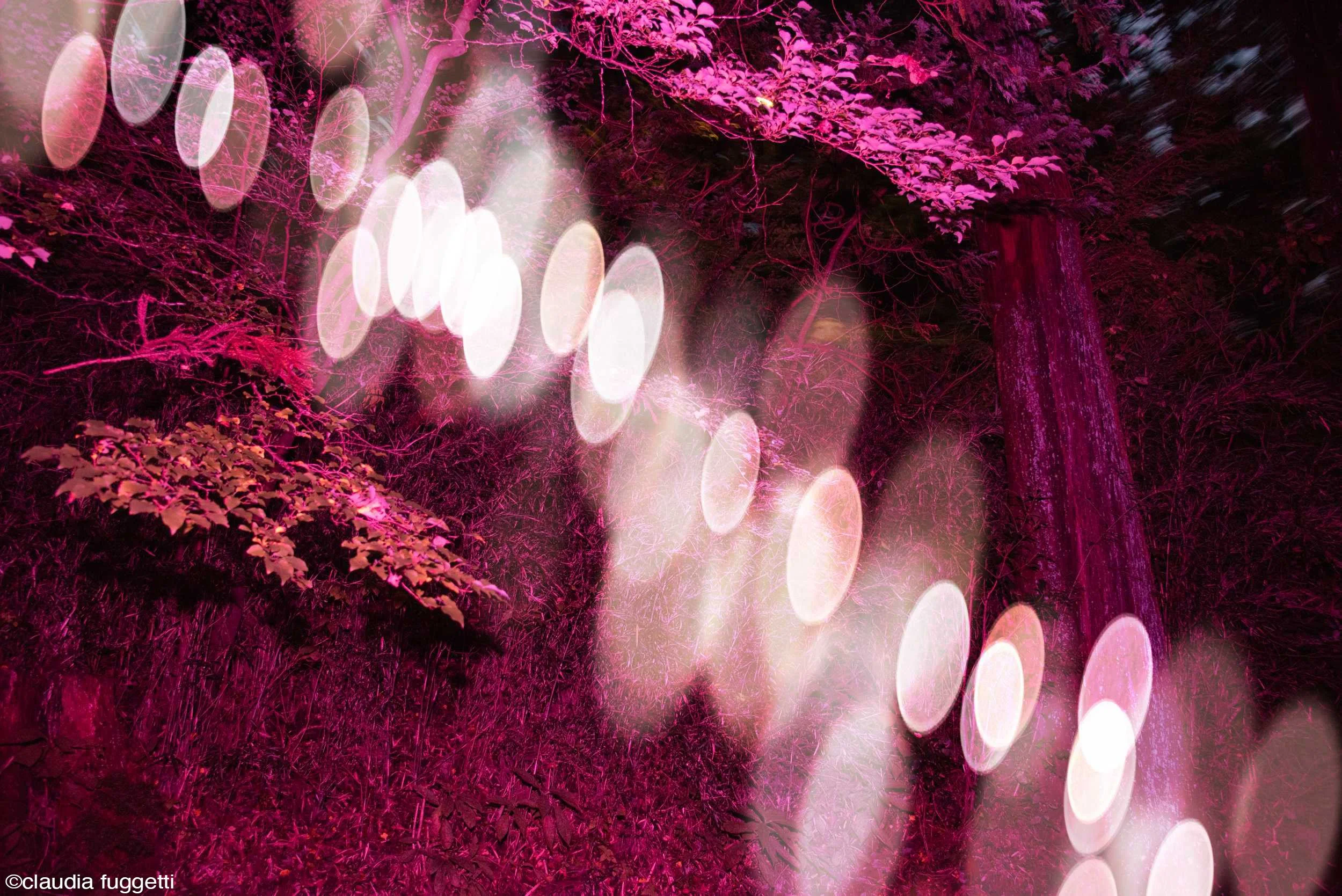
For this final response, I moved toward light as transformation. The forest opens into overlapping traces, and perception shifts across layers of brightness and shadow. The landscape no longer holds a single form, it becomes a field of luminous transitions.
After your image of restraint and impact, this feels like a moment of metamorphosis. Not a rupture, but a passage, where density softens into vibration, and matter slowly gives way to sensation.
I feel our visual dialogue has travelled from water to air, from fabric to light, from body to perception. It closes not in resolution, but in transformation.
Thank you for this generous exchange, I’ve deeply valued the attentiveness and openness of our shared process.
Warmly, Claudia
Lara:
Your forest no longer behaves as a stable environment - the fractured light transforms it and loosens its structure. The landscape feels very temporal as though something is passing through it. Your play with light gives the feeling of the forest dissolving into overlapping traces.
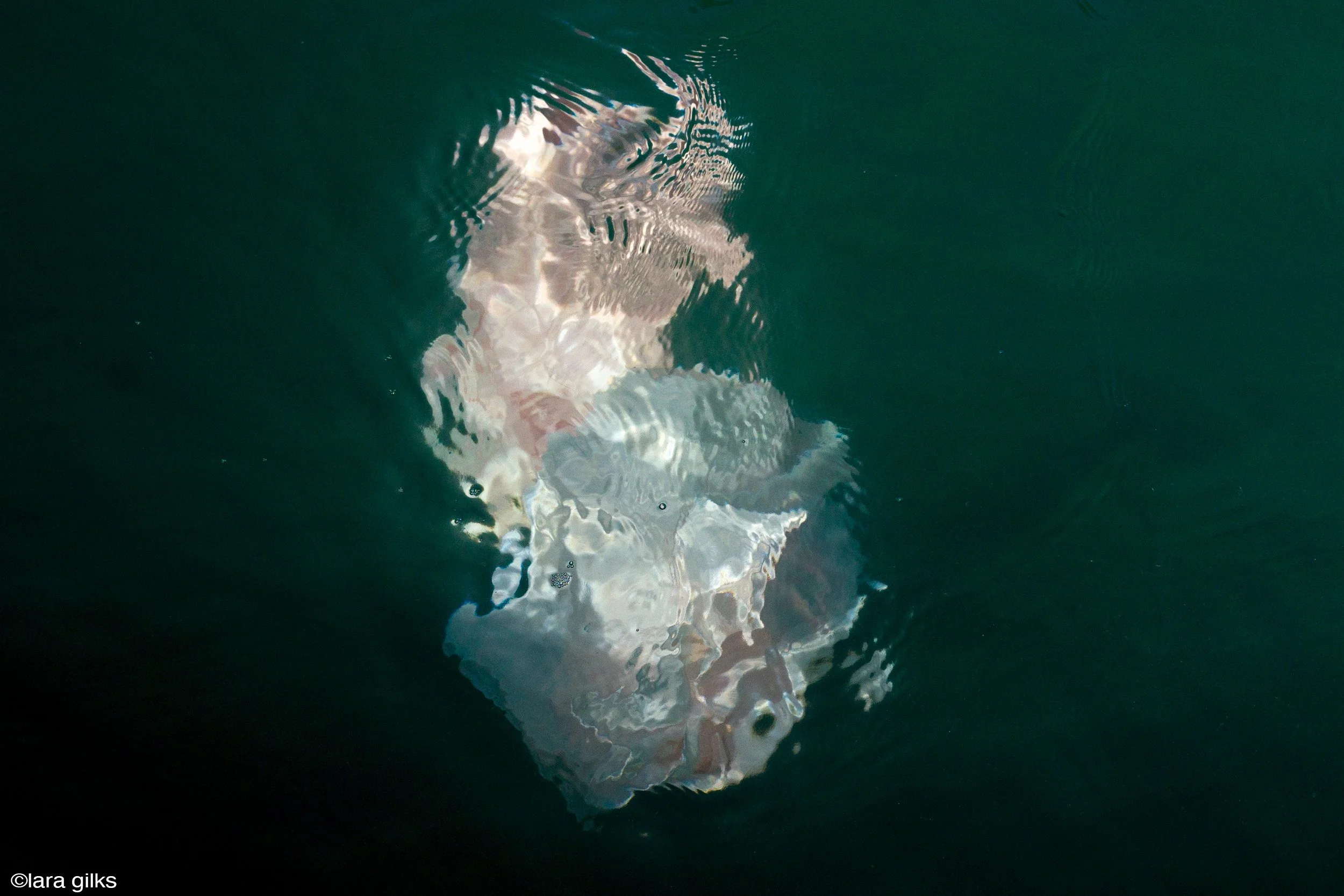
In my responding image I return to water without weight or struggle. The fabric no longer resists or entangles - it dissolves. Reflection and refraction fragment the form and the fabric hovers between visibility and disappearance.
Neither image offers a fixed subject instead both touch on transition - on light in motion. The images echo one another structurally being layered, unstable and unresolved. Together they feel like a final threshold in our dialogue not a conclusion but a state of transformation.
We did it….I have loved this process.
Thank you, Lara
Following the collaboration we asked Claudia and Lara about the experience.
What was your personal experience of A Visual Dialogue process?
Claudia Fueggtti: For me, A Visual Dialogue was an experience of attentive listening through images. Rather than responding conceptually, I allowed each photograph to guide my perception, letting colour, light, and atmosphere shape the next gesture. It felt less like producing work and more like entering a shared perceptual field, where meaning emerged slowly through visual exchange.
Lara Gilks: It was a privilege to be invited to take part in A Visual Dialogue and this was a new experience for me. I found the process both thought provoking and challenging, particularly the dialogue aspect of working in response to another artist within a shared framework.
How do you feel about the outcome?
Claudia Fueggtti: I feel the outcome holds a delicate balance between contrast and continuity. The dialogue moved through different elemental states: water, air, land, and light, while remaining connected by colour, alteration, and perceptual shifts. What I appreciate most is how the images never aimed for resolution, but instead created a space of transformation, where presence remained fluid and open.
Lara Gilks: Our shared dialogue moved through several concepts and ultimately concluded with more questions than answers. I feel we both stayed true to our individual styles while also allowing space for a genuine exchange. In particular I think we made some strong and sensitive connections through a couple of the diptychs.
How will this affect the way you work, or think about making work in the future?
Claudia Fuggetti: This dialogue reminded me how important it is to stay open while making work, to allow images to lead rather than trying to control their direction too early. Working in response to another artist encouraged me to trust intuition, atmosphere, and subtle shifts in perception. It also reinforced my interest in transformation as a process rather than a result: letting images evolve through listening, exchange, and uncertainty. Moving forward, I feel more inclined to approach my practice as a continuous state of becoming, where work emerges through attention, vulnerability, and responsiveness, rather than fixed ideas.
Lara Gilks: I would definitely be open to collaborative projects in the future and interested in a project involving multiple participants. One thing I might change is alternating who initiates each response in a turn based dialogue. I think shifting that rhythm could further balance the exchange and open up new and unexpected directions for how the work evolves.