
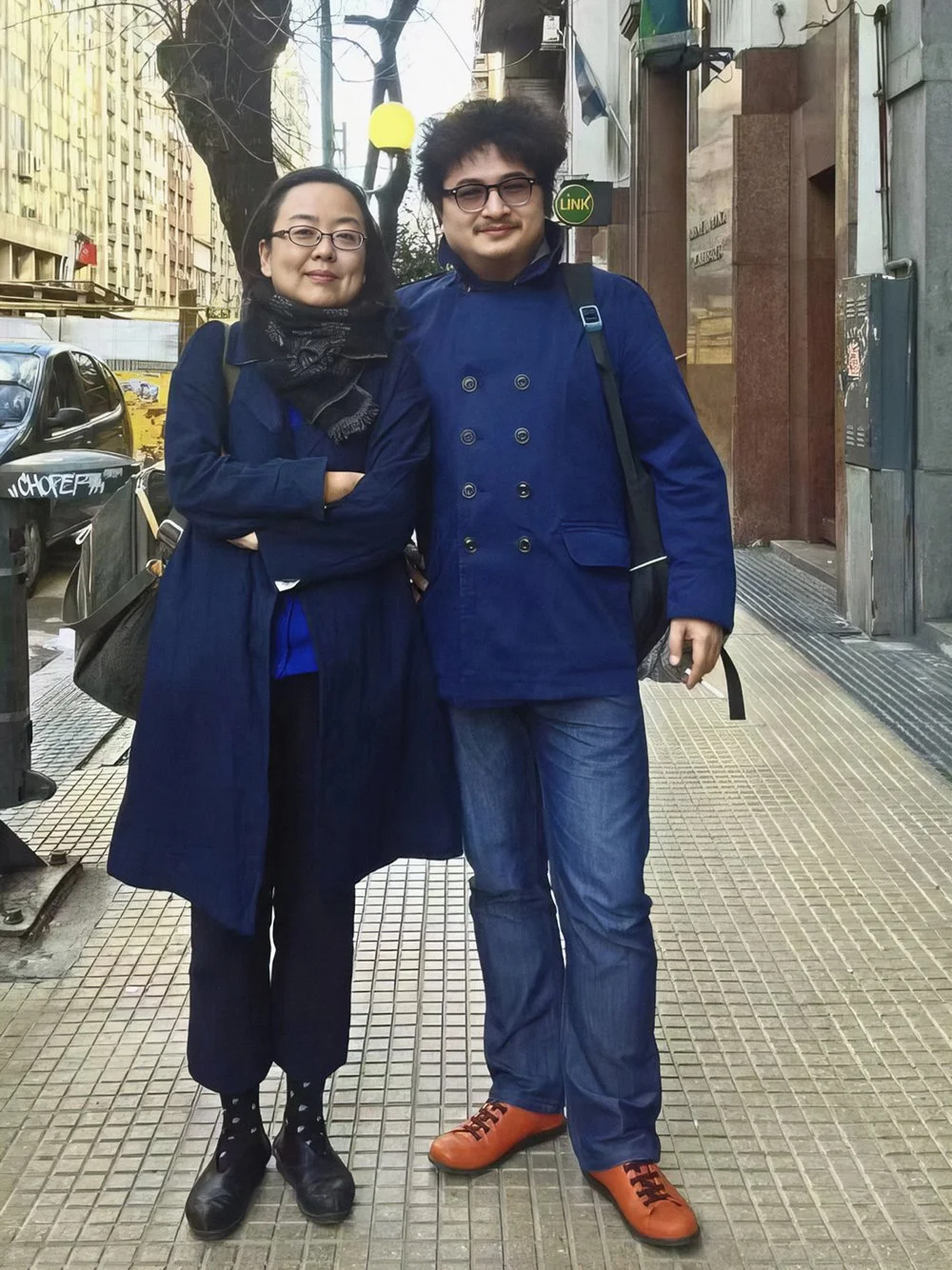
interview
yuting duan
darmon chang
founder and director of the lianzhou foto festival and the lianzhou museum of photography
photographer, curator, and photography critic
lianzhou, china
How do you define your role in the photography world?
YuTing: I started as a journalist and editor for a photography, news, and commentary platform, then became a photo editor at a social news newspaper, and later a curator who founded an international photography festival and museum. These shifts in identity gave me a broad perspective—from photography as a practice to photography as a medium of communication—and the chance to build platforms that connect it more deeply with the world. Through them, photography engages in dialogue with the outside via its unique visual language, while I continue to explore the medium’s own possibilities.
Darmon: I find it hard to confine myself to a single role. Labels like “photographer,” “curator,” or “critic” feel external. What truly drives me is a persistent skepticism toward both images and language. For me, photography is not just an aesthetic object—it is a fissure in the era, a grammar that both reveals and conceals. I prefer to think of myself as a “witness”: to how images are produced, and how they are mobilized, consumed, and forgotten.
Why do you do what you do?
YuTing: God gave me eyes that are keen at reading images, and I’m glad to put that gift to use. In an era of explosive image production, images require sorting, and viewing requires guidance. To discern what deserves to be shown and discussed—and what does not—is crucial, because photography, as another form of human language, remains vital and captivating in today’s world.
Darmon: Because photography still touches our most everyday public experiences. It is not an isolated art form; it runs through news, social media, family albums, collective memory. In these daily spaces, photography reminds us we are not isolated individuals but share the same time and space with others. As society grows accustomed to fast-food language and fragmented signs, photography lingers as something slower, something that asks us to look. That is why I persist: it shows that publicness is not an abstraction, but the traces through which we see and remember one another.
Where do you look at photography work? How do you discover new artists?
Yuting: I often browse the websites of international and domestic photography institutions and festivals (MoMA, ICP, Swiss Foundation for Photography, Les Rencontres d’Arles, Jiazazhi, etc.). Friends, colleagues, and collaborators I’ve worked with over the years—curators, artists, editors, even gallerists and students—regularly send me updates about new works. Because of my long involvement in this field, recommendations come in from many directions. On top of that, serving as a juror for international photography awards and funding programs constantly exposes me to emerging artists of real quality.
Darmon: I don’t have a fixed route. Friends’ recommendations, chance encounters at small shows, forgotten publications, even obscure corners of the internet often yield more surprises than large art fairs. I don’t chase “first discoveries.” I’m drawn to works not yet polished by institutions—those with a raw edge and an unfinished vitality. Their power lies in their resistance to tidy frameworks, in preserving a rough freedom of language.
What is the most significant challenges facing contemporary photography today, and what is the greatest opportunity?
Darmon: The biggest challenge is that photography is being domesticated into “exhibitable spectacle.” Institutions, media, and markets tend to favor consumable images, dulling photography’s sharp edge. But the deeper issue is the torrent of images in the AI and platform era. We no longer face only photographs, but a world of images endlessly generated, distributed, and filtered by algorithms and capital. Whoever controls the data and models rewrites the value system of images. Photography is no longer only art or record; it is pulled into new power structures, perhaps even enlisted to legitimize them.
And yet, precisely because images are everywhere, people are beginning to doubt them, to ask again: “What is photography?” That doubt itself is the opportunity. When the line between real and fabricated is fully blurred, photography’s future is no longer about guaranteeing truth, but about holding onto what algorithms cannot predetermine: fleeting accidents, incomplete traces, cracks left by time, ethical demands.
In China, the entanglement of challenge and opportunity is even more complex. On one hand, the country is swept into the same global flood. On the other, it faces urgent realities: institutional transitions, social ruptures, gaps in collective memory. AI may make Chinese photography easier to fit into international grammars, but its real value lies in whether it can bring us closer to our own fissures and dilemmas.
In short, AI is not photography’s end but a magnifying glass, revealing the medium’s most fragile and unique parts. The future of photography will not be as a guardian of truth, but as a witness to uncertainty—forcing us, amid illusion and noise, to seek the irreplaceable.
Yuting: I agree.
When you look at the current state of photography, what, if anything, do you feel is missing from the conversation and the work being produced?
Yuting: Let me give an example. Back in 2007, at PhotoEspaña in Madrid, I saw the work of Japanese photographer Rinko Kawauchi for the first time. It was a completely different kind of viewing experience—so delicate and sensitive that I felt the photographer dissolved into what she photographed. A sunlit orange, a drop of milk at a baby’s mouth, a melting block of ice—these weren’t just subjects, they floated weightless, as if time itself congealed them. Right next door in the same festival were Edward Burtynsky’s monumental industrial landscapes—impressive, yes, but Kawauchi’s quiet intensity stayed with me far longer. What was missing in photography at that time was exactly that: an inward, almost spiritual search, a new relationship with the world. At its best, art offers this immediate connection, not merely the residue of influence or training. Without crossing those traces, you cannot really glimpse the essence of the world.
Darmon: Contemporary photography has plenty of works engaging with identity, gender, environment, technology—these are vital. The risk, however, is that institutions and markets often reduce them into shorthand tags, flattening their depth. What we need more of are works willing to step aside from the hot topics, works that may feel out of place. They don’t always align with the moment, but precisely for that reason they can leave temporal gaps—spaces that might become memories for the future.
What advice would you offer to an “emerging” photographers who wants to get their work noticed?
Darmon: Don’t rush to be seen. Visibility often means being absorbed into existing frames, even consumed by them. What young artists most need is to find their own way of seeing, not to prove “I was here” by joining pre-set structure. Sometimes silence protects a work’s strength better than noise. Most importantly, let your work grow in its own context, rather than scrambling to answer questions imposed from outside.
Yuting: If you truly love photography, guard this love like a secret affair. Even under pressure to survive, find a way to keep it safe—that takes wisdom and patience. When the chance to declare yourself arrives, go test the waters, but never abandon the most genuine sensation that drives you. Your “newness” is exactly why the market, the critics, the noise will come to devour you. Let them. Don’t become the shape they prefer.
The art world is less centered on traditional hubs like New York and London. How impactful is this decentralization? From your perspective, what are the promary opportunities and challenges for Chinese photography and photographers in today’s international market?
Darmon: It is a liberation: no more fixating on New York, London, or Paris. But decentralization doesn’t mean “no centers”—it means new ones are constantly emerging. The challenge for Chinese photography internationally is how not to be consumed as an “exotic spectacle.” The opportunity is that we can finally bring our own language, history, and memory into the conversation, narrating our experiences on equal terms rather than echoing someone else’s grammar. The real challenge is not swapping centers, but refusing to be framed by any. If decentralization only changes the stage, photography still gets consumed; only by resisting enclosure does it truly begin.
YuTing: Decentralization signals a more equitable approach to cultural exchange, an opening from centers toward peripheries. It reflects the shift from modernist to postmodernist art, shaped by history, politics, economics, and globalization. In truth, core discursive power hasn’t fundamentally changed. But optimistically, it has broadened horizons, created wider channels for exchange, and increased the fluidity of Chinese photography. This openness has energized artistic production—from exhibitions to publications—and brought new diversity to the field.
How is the work of curators like you curators like you shaping the international perception and value of Chinese photography?
YuTing: To “shape an image” risks putting on a performance for others. What matters is how we ourselves understand and build our own image and value. On one hand, we must dismantle long-standing Orientalist stereotypes. Since the 1990s, when Chinese photography entered the international market, many works have catered to Western expectations by using familiar “Eastern” symbols. These are easily accepted but fail to reflect a true China. In three or four decades, the country has risen from a developing nation to the world’s second-largest economy—a transformation full of contradictions and tensions. Curators must look here to find works that bear the imprint of their times. On the other hand, it is essential to support artists who engage with photography’s essence—those who understand its sociological intersections and technological shifts (AI, social media), yet remain rooted in experimentation and creative language, expanding photography’s possibilities.
Darmon: Curation is not translation, though we are often forced into that role. What matters more is resisting single narratives. Chinese photography is not a neat story or coherent style—it is multiple, fractured, contradictory. If curation allows these contradictions to coexist, the world might see its complexity—like China itself—rather than a polished version.
Are ther any particualr visual styles, themes, or approaches that you believe are central to contemporary Chinese photography?
YuTing: Since the 1980s, when photographers first began to create with strong subjectivity—beyond a few pre-1949 practices—it has been difficult to define a core style. Magnum-style documentaries have had the deepest influence, long dominating the Chinese scene. With globalization, contemporary Chinese photography has absorbed European, American, and Japanese trends. While documentary remains central, its methods and subjects have broadened: urbanization, migration, environmental change, identity, tradition, new technologies and media, explorations of photographic language itself.
Darmon: I don’t believe there is a stable “core.” If anything, it is a persistent sense of fracture: between history and the present, urban development and personal memory, language and lived experience. These are not flaws but generative conditions. They give Chinese photography a provisional, unfinished, contradictory quality - yet precisely for that reason, it reflects contemporary China’s lived reality more truthfully. Unlike Western photography, with its long systematic aesthetics, Chinese work keeps probing its place amid rupture and reconstruction. Its strength lies not in a core, but in ever-emerging rifts and temporariness.
Can you name some projects by “emerging” photographers that have recently captured your attention? What made the work stand out to you?
Darmon: Honestly, in the past two or three years I’ve rarely encountered “emerging” photographers who truly surprised me. Many young artists trained abroad create works that closely resemble those of their peers in Europe or the U.S. This exchange is valuable, yet when global issues—gender, identity, environment, ethnicity—are introduced wholesale, they sometimes fail to resonate with local concerns, creating a sense of detachment from lived realities in China. These topics are globally important, but in China they unfold with different rhythms and pressures, and overlooking those differences risks losing the deeper ties to local experience.
This spring, at a retrospective of award-winning works, I raised a critique: in some pieces, language seemed to overtake seeing. When artist statements leaned too heavily on standardized frameworks, the photographs’ complexity was buried. There is a danger that institutional logic can overtake lived experience—so that instead of deepening complexity, works are too easily read through familiar templates, losing some of their force. This isn’t an indictment of individuals, but of the broader system that privileges language over experience.
Yuting: The pandemic and its aftermath hit China hard, and as a result artistic innovation and the emergence of new voices have slowed. What I see instead is that mid-career artists—such as Birdhead Collective, Taca, Zhang Xiao, Zhang Wei, Chen Zhe, Qiu—have continued to sustain their creative vitality. Younger returnees from overseas are still in the process of finding momentum, building their language and position. At this moment, Chinese photography feels caught in a kind of generational pause.
If you could own one photographic image and price and availibility were not an issue, what would it be?
Darmon: I don’t much wish to “own” a photograph—once privatized, its publicness shrinks. If pressed, perhaps one by the veteran Weng Naiqiang: a group portrait from sixty years ago of sent-down youth on two wooden boats in Beidahuang. The faces seem trapped in an unfinished era. It is history, and it is a wound, reminding me that photography is not just looking but entangled with ethics and responsibility. Some photographs are not collectibles but shared scars of public memory.
YuTing: I’d choose Birdhead’s mixed-media work Photos Are Garbage.
Anything you would like to add?
Darmon: What fascinates me most about photography is its instability as language—it summons reality while fabricating illusion, records while becoming rhetoric. AI has amplified this instability: it makes images easier to generate, blurring the line between truth and fiction. But this doesn’t mean photography loses value. On the contrary, it shows us where its true power lies: not in guaranteeing truth, but in revealing what simulation cannot touch—time’s delay, the hesitation of looking, the entanglement of accountability.
For me, photography’s value is not in answers but in the new questions and new fault lines it keeps opening. AI may flood us with images, but it cannot replace photography’s force to confront realities we are unprepared for. Its worth is reborn again and again in that confrontation.
Yuting Duan
Founder and Director of the Lianzhou Foto Festival and the Lianzhou Museum of Photography - the first public institution in China dedicated to the photographic medium. Duan has long been committed to curatorship and the promotion of contemporary photography in China. She is the author of Ten Years of Contemporary Photography in China 2005–2014, and has served as a nominator for the Hasselblad Award in Photography and the Prix Pictet.
As Artistic Director of the Lianzhou Foto Festival, Duan has initiated and curated numerous editions since its founding, and was named one of the “Top Ten Figures in Chinese Photography” in 2005. She has been invited to serve as juror or curator for Fotobild (Berlin), Photoquai (Paris), Houston Fotofest, Kyotographie (Kyoto), and Photo Biennale Denmark, among others, as well as a juror for the LensCulture Exposure Awards and the China Photography Awards.
Darmon Chang
Photographer, curator, and photography critic. He has served as Artistic Director of the Lianzhou Photography Festival and Artistic Director of the Lianzhou Museum of Photography.
Since 2004, Chang has been actively engaged in contemporary photography. His works and publications have been presented at photography festivals and museums, and have received several awards.
Since 2009, he has curated numerous exhibitions and written widely on photography criticism. He has also been invited to curate for photography festivals and museums, and to serve as a portfolio reviewer, nominator, and juror for several photography awards.
His work across curating, writing and editing is premised at the intersection of politics, culture and social justice. His working method foregrounds building kinship and solidarity, as tools to collectively imagine alternate, reparative futures.