
interview
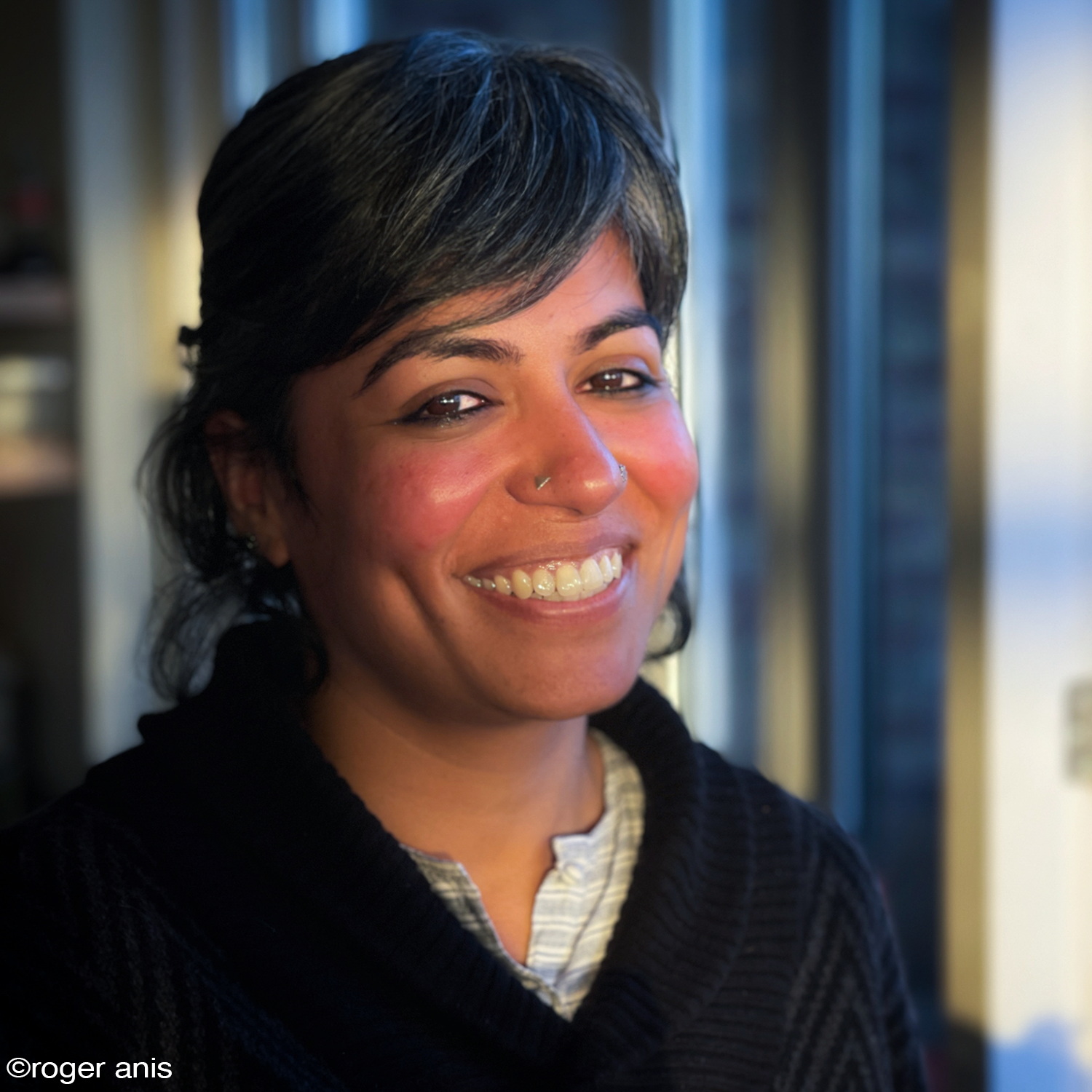
tanvi mishra
photo editor, curator, writer, educator
india
How do you define your role in the photography world?
In my practice of working with images and image-makers, my role shifts from encounter to encounter and project to project. At times I serve as an interlocutor, at others a sounding board, and even sometimes as a custodian.
It is not relevant for me to concern myself with what my ‘role is in the photography world.’ It is more important for me to recognise, and understand, what potency images contain—as agents of witnessing, as keepers of memory, as devices that can be moulded and manipulated to anyone’s gain. Images have the power, in their singularity or in their reiterations, to shape public memory and opinion. They reveal, as much as they obfuscate. I remain fascinated by the ability of photography to still hold relevance, despite many pronouncing its death, repeatedly, almost since its invention. Amidst all the claims of numbness purportedly created by the surplus of images, I am taken by their ability to continue to agitate and propagandise. In the relentless ability of the photograph to continue to provoke.
In such a shape-shifting, pluralistic and charged atmosphere in relation to the image, our roles in relation to photography, as a conduit or a medium, is perhaps what is of deeper interest. I look towards images, in their political and social functions, to help me garner one understanding of our world. Maybe it is a language that I have tried best to understand, and constantly learn how to be fluent in. For eg. it is through all these years of editing images that I have come to accept their inherent ambiguity, and the questionable bind between photography and authenticity. This long engagement has helped shape my understanding of the manufacture of narratives—not just within photography, but all around us in the world today.
My work in relation to image-making—whether it is writing, curating, editing or teaching—allows me to be in dialogue, and community, with other thinkers and makers. I find this collective gathering to be invaluable, shaping me as a cultural worker, and as a citizen. It would be foolish of me to think that there are strict distinctions between my life in and outside of the photography world, especially if images are the vocabulary that renders a reading of the world. I feel my role and function in one is deeply intertwined with, and shapes, the other.
Why do you do what you do?
Because we all need a purpose in life, a goal worth moving towards.
I find that photography and images at large allow me to engage more deeply with society and the world, beyond my immediate reality. That understanding shapes my thinking, and perhaps influences the dialogue I can have with those in my vicinity.
Where do you look at photographic work? How do you discover new artists?
All kinds of places – exhibitions, writing on photography, juries, portfolio reviews, Instagram, recommendations from friends and colleagues.
Often through conversations and community.
What is the most significant challenge facing contemporary photography today, and what is the greatest opportunity?
Photography has always faced ‘challenges’ and has managed to transform into new forms or directions that may have felt unimaginable, or as a ‘catastrophic developments’ in the preceding era. These ‘mutations’ have only helped make it as dynamic a medium as it is.
In this regard, it is hard for me to build a hierarchy of challenges – whether it is AI, or the ease of digital manipulation; the complete collapse of authorship or regard for photographers/photography departments in the press/journalism fields in our region at least; social media, while a vital tool of dissemination, also becoming a mechanism for the ‘easy’ consumption and validation of images in the attention economy.
However, what may be of concern is prescriptive conditions imposed on what the value of art-making should or shouldn’t be. Some may choose to engage with it as a social tool, others may not. And that is fair, and the prerogative of the individual/collective.
However, for many of us that often choose to work with image-making in dialogue with societal concerns or issues, one of the biggest challenges is the conditional support offered towards certain projects that mobilize dialogue that is different from the ‘accepted’ norm or narratives. The cancellation the 2024 edition of the Biennale für aktuelle Fotografie in Mannheim on the accusation of antisemitism towards one of its invited curators—Shahidul Alam—on account of his support for Palestinian self-determination in the face of Israeli genocide is one such example. At the time of writing this, Photo Kathmandu, an international photo festival in Nepal, faces a crisis of funding as support is revoked on account of their political stance, of local and global issues of political and social concern. This move towards depoliticising cultural work through withdrawal of resources is a trend of concern—that is weaponised not just by the ‘West’ but also resource-rich institutions/individuals in the Global South. This is equivalent to censorship. It stands to threaten the cultural space as a vital incubator for critical conversations, and also as a place to build imaginations that may well be imperfect and evolving, but embody distinct shifts from both historical and contemporary dominant narratives.
Maybe the greatest opportunity stems from the current political moment. In these fraught times, of the lifting of the western liberal artifice, and complicity of western media in perpetrating colonial thinking, we are freed from the illusion of these as sites of fostering free speech and thought. Perhaps we can learn from this awakening, to build solidarities that are premised on shared concerns, and resonant political goals. These solidarities need not be shaped based on identity or provenance—for we know that we are all defined by more than our nationalities, regionalities or other singular identity markers. These shared solidarities can perhaps be premised on our positionality instead—what do we intend to say/do with our work. This can be an exciting prospect. Much of what I have learnt is from peers—to be in conversation with them physically, or with their art or writing. I hope these spaces continue to flourish.
When you look at the current state of photography, what, if anything, do you feel is missing from the conversation and the work being produced?
I am currently interested in exploring whether photography is capable of illustrating implication. We are very familiar with the repeated link of photography and consequence—whether it be images of war, genocide, climate catastrophe or violence towards any marginalised groups. What we are not so familiar with is how can image-making be utilised to showcase causality. Is it capable of demonstrating complicity, collusion and collaboration in systems of power? I feel that we would benefit from more work being produced that helps us understand what helps violent and oppressive systems—whether these are racial, casteist, gendered, technological, or capitalist hierarchies—to form, sustain or flourish. I am curious to see how artists use photography to visualise these ‘non-incidents’ or and if the medium can be harnessed to showcase that which is invisible, but insidious, in today’s world.
What advice would you offer to an “emerging” photographer who wants to get their work noticed?
I don’t want to give advice to any category of image-makers, whatever stage of career they are in. We are all in a low attention economy, where getting ourselves, or our work noticed, is hinged on self-promotion, access to networks and often, access to other resources like money or time. Much of it requires us to be “present”, either physically or online, in locations where we may be “noticed.” I am still trying to figure this out for myself, as there is considerable discomfort associated with promoting oneself, and at the same time there is a desire to share one’s work with the world.
Maybe the answer lies in identifying which communities, conversations, or individuals we would wish to be in dialogue with. It is not possible to be visible everywhere, nor is it desirable. If there is genuine intention in connecting, because of shared interests or shared sightlines of work, sometimes writing to people directly can yield honest results. I get many such invitations for connection from artists as well as other cultural practitioners, and I try to respond, whether I can collaborate at the time or not. In other cases, I have had some valuable conversations, and sometimes repeated encounters, intitiated through portfolio reviews. Photographers can look out for these, and ideally if they are free or significantly subsidised, they can set up the environment for a first conversation. It is up to the two individuals to then carry the conversation forward from there.
The art world is less centered on traditional hubs like New York or London. How impactful is this decentralization? From your perspective, what are the primary opportunities and challenges for South Asian photography and photographers in today’s international market?
I don’t think that the ‘art world has been decentralised’, particularly not in its commercial apparatus. There continues to be a skewed distribution of resources, with the West or Global North institutions having much more money to invest in art and culture. This is not a coincidence, but an outcome of imperial histories of the world, and how they play into current economic realities.
I think the ‘decentralisation’ you speak of can be seen as two-fold – one that art making was always decentralised. I say this, because there have been histories of art and art production in all corners of the world. When seen from the Western perspective, they are positioned as a new or recent phenomenon, but when viewed from another axis, they have their own lineages that are distinct from Western art histories.
The second interpretation of this notion of ‘decentralisation’ that we can make is that there is a recent turn by Western institutions or art ecosystems towards practices outside of the Global North. Maybe with the advent of the internet, the circulation of images, and opinion, is increasingly unfettered. There is a larger visibility towards practices from ‘outside’ of the Western art world, without it necessarily being funnelled or vetted through Western editors/curators as before. With all the conversation surrounding decoloniality, diversity and inclusion—which have been taking place not just in the art industry, but across genres and fields—institutions have been forced to engage with practices that may not have historically been regarded as “valuable” in their metrics. This shift is not to be easily dismissed, as there is genuine intention to do “correctional” work on part of some, but there is also the acknowledgment that if institutions do not do this, they would be deemed as not being “progressive”, a label that would be damaging in the present moment.
I am not someone capable of commenting on the ‘international market’ as most of my work is in the non-commercial curatorial space. However, I can say that the opportunity for Southasian photographers is the same as its challenge—to make use of this present moment, to circulate their work in spaces and audiences that were earlier resistant or disinterested in the same. This can lead to new avenues but can also risk being caught in the bind of being tokenised for your identity. It is up to us to decide how we wish to play the cards that are laid out, to enter these spaces to pursue critical discourse within them, find others in solidarity or refuse them entirely. In this refusal, also lie other possible trajectories—to engage with spaces outside of the Western and Global North art ecosystem altogether, which can offer shared solidarities of histories of struggle and an impetus towards learning of each other’s contemporary contexts. Both collaboration and refusal can be valuable strategies, and artists should think through them as creatively as they do in the making of their work. .
How is the work of curators like you shaping the international perception and value of South Asian photography?
I don’t think it is my place to answer how my practice determines the ‘value’ of any kind of photography. I do not wish to be a broker of practices of one region for another.
I do, however, recognise that I work in the ‘international’ photography landscape, and often feel the pressure (or responsibility) to bring practices from outside of the Global North, when I am engaging with their audiences. While I am happy to do so, as I find the Global South to have many exciting practitioners, I also don’t wish to be limited by region or nationality. What is of value for me is to create a meaningful curatorial premise, and to bring practices in dialogue and adjacency, that can expand our ways of thinking around certain ideas that may be familiar to us.
Are there particular visual styles, themes, or approaches that you believe are central to contemporary South Asian photography?
I don’t think it is fair to even attempt to identify a region as large as Southasia with a particular visual style or thematic. I often rely on the words of Kanak Mani Dixit, the founder-editor of Himal magazine who proposed the single word Southasia as a vast “penumbra” of intermingling cultures and practices and proposed for it to be seen more as a “sensibility than a geographical region.” I think this can be a guiding force to look at practices from here and the crossovers that emerge within them.
PIX, a project I was involved with for a decade (2011-2020), attempted to trace some of the concerns that image-makers and visual artists were responding to at that moment. Functioning as a Southasian publication and display practice, it was envisioned as an archive of contemporary photography practices in the region. We chose to gather these practices through theme-based issues – observing transition in societies at times of critical political shifts in Vol VI titled Metamorphoses (Special Issue on Sri Lanka) or Vol 12 titled Renewal (Special issue on Afghanistan), identifying the place of an individual in the city, the State or the region in Vol 17 titled Citizen Issue or exploring diaspora and its expanded definitions in Vol. 19 titled Passages – a subcontinental imaginary etc. The PIX archive serves as a resource for research to help us identify traces of how political movements on the ground shaped a country’s cultural infrastructures for eg. the impact the Islamic Revolution (1979) had on visual culture in Iran versus say, the ramifications of the civil war in Sri Lanka (1983-2009) on the visual cultural ecosystem on the island in a similar time period. Through this project we were also able to build dialogue amongst practices within the region. The issue titled Freedom (Vol.III ) carried performative self-portraits by Nariman Ansari that identified stereotypes of women in Pakistani society alongside the visualisation of women’s sexual fetishes by Andrea Fernandes based in India. In Vol. IX titled Embody (The Gender issue), queer women in Bangalore, India performed as drag kings in Indu Antony’s series Manifest alongside Sachini Perera and Natalie Soysa’s series Projecting the Sri Lankan woman where female bodies carried the prejudices and stereotypes perpetrated in mainstream media in Sri Lanka.
The thematics, styles and methodologies of photography in Southasia are as varied, and fluid, as the region itself. These evolve alongside the medium, as well as in response to the current discourse - both specific to the form and also in society.
Can you name some projects by “emerging” photographers that have recently captured your attention? What made the work stand out to you?
I don’t wish to use the term ‘emerging’ or ‘established’ for any of these practices. These are recent projects that are of interest.
Feminist Memory Project by Nepal Picture Library
The Ajaib Ghar Archive by Philippe Calia
Instruction (video) by Felipe Romero Beltran
Caribbean Dreams by Samantha Box
Master Rituals II by Tarrah Krajnak
HUN (photobook) by Julia Mejnertsen
If you could own one photographic image and price and availability were not an issue, what would it be?
Imagen de Yagul, Ana Mendieta, 1973
And most images from Masahisa Fukase’s Sasuke
Anything you would like to add?
N/A
Tanvi Mishra works with images as a photo editor, curator, writer and educator. Her areas of interest include rights and representation in image-making, refusal as visual strategy and the notion of truth/fiction in photography.
Her recent curatorial projects include "Isadora Romero: Fume, Root, Seed" at Musee Neimenster, Luxembourg (2025) and Photo Kathmandu, Nepal (2025) and "Moving Definitions: an Invitation to re-view" at Recontres d’Arles (2023), France. She has served as the Creative Director of The Caravan, a journal of politics and culture and on the editorial team of PIX, a Southasian publication and display practice. Mishra was an invited curator at Photo Kathmandu (2016) and the Breda Photo biennial (2022), and part of the curatorial team of Delhi Photo Festival (2013, 2015). Her writing on photography is published widely including in FOAM Magazine, NO NIIN Magazine, 1000 Words, Aperture and the Routledge Companion to Global Photographies. She has taught with photo.circle, Pathshala South Asian Media Institute, the International Center of Photography and VII Academy, and conducted independent workshops on publishing as practice.
Her work across curating, writing and editing is premised at the intersection of politics, culture and social justice. Her working method foregrounds building kinship and solidarity, as tools to collectively imagine alternate, reparative futures.
News:
Exhibition There Are No Love Letters Here at Serendipity Arts Festival in Goa, India
December 14 - December 21, 2025
Exhibition Rights of Passage at Chobi Mela - International Festival of Photography Bangladesh in Dhaka, Bangladesh
January 16 - January, 31, 2026