
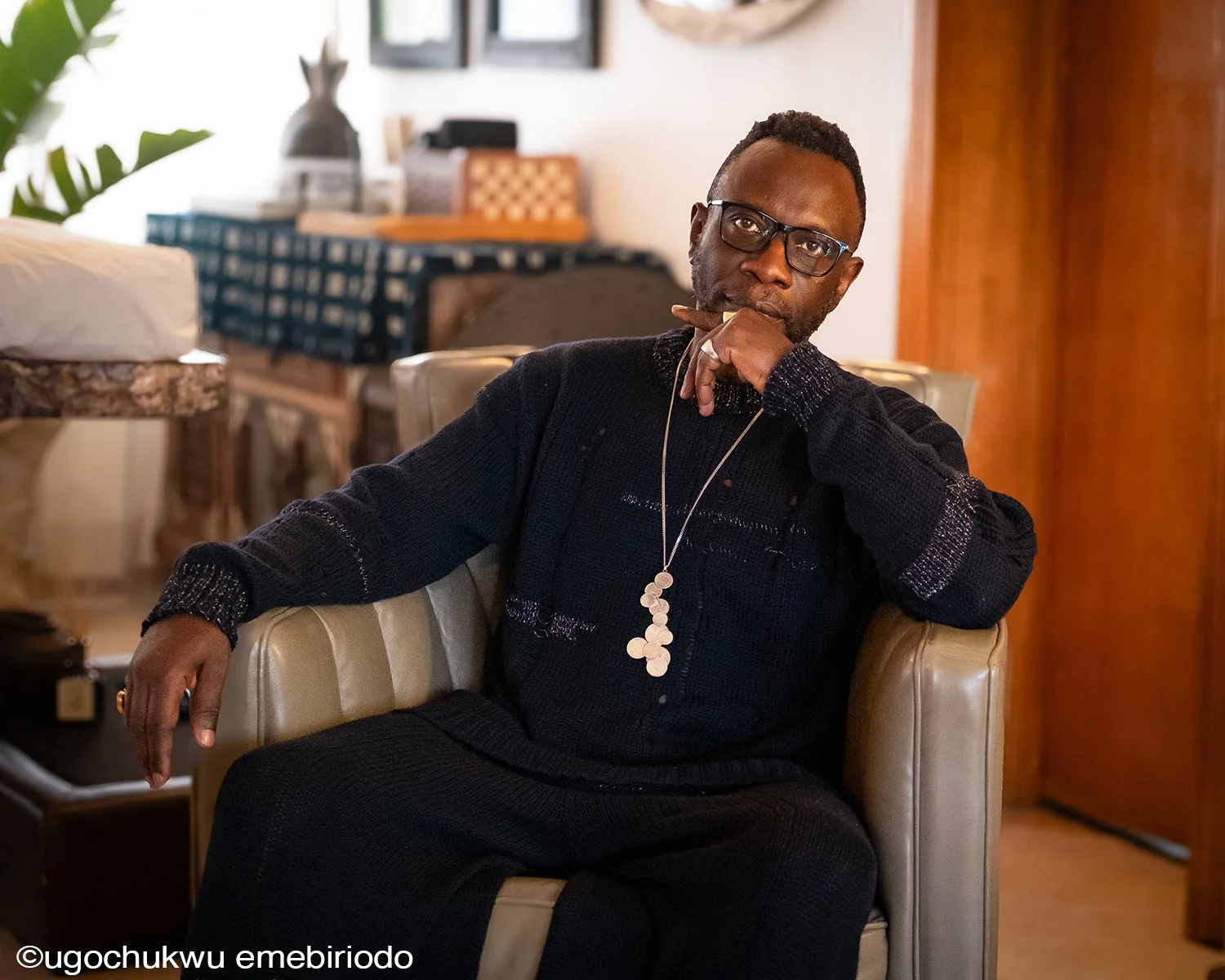
interview
azu nwagbogu
curator, founder and director
african artist’s foundation
lagos photo festival
lagos, nigeria
How do you define your role in the photography world?
I don't, honestly. The moment you define your role, you've caged yourself. I like to think of my motion as very fluid and at times liminal, at thresholds.
But if I had to... I'm interested in creating opportunities for younger thinkers willing to do the work to thrive and embrace a new way of doing this work we call curating. And if you ask about LagosPhoto, it isn't about elevating African photography to some imagined standard. It's about questioning what photography even is, what it's been used for, how it's complicit in systems of control. My role is to hold space for that questioning.
Sometimes that looks like curating. Sometimes it looks like provocation. Sometimes, as with LagosPhoto 2025 ‘Incarceration’, it looks like just pointing the finger, offering guidance and getting out of the way.
Why do you do what you do?
Because I'm still a very romantic person. I care. About artists, their narratives, their journeys and society in general. I can’t be cynical and really just enjoy the idea of me just “be—in”. Not chasing not worrying—just to be and utilise what abilities I have to do my bit.
Where do you look at photographic work? How do you discover new artists?
Everywhere especially where I'm not supposed to look.
The usual channels - the MFA programs, the portfolio reviews, the festivals circuit are fine but they tend to reward a certain kind of legibility, a certain performance of professionalism that often smooths out the edges that make work interesting. There are gaps. One of the most exciting bodies of work I’ve seen in years and on view at LagosPhoto 2025 is by Stefan Ruiz. It came to me through a friend Timothée Verrecchia, who is a great character and when I discussed the ideas around incarceration, he immediately said, “Azu, you got to meet Stefan Ruiz”. As a long term body of work capturing various ideas around one topic, it does not get more obsessive not more powerful than the 30 year body of work by Stefan and you would not believe it but It’s never been exhibited before now.
What is the most significant challenge facing contemporary photography today, and what is the greatest opportunity?
The challenge and the opportunity are the same thing - photography's complicity in surveillance capitalism.
The Challenge: We're drowning in images. Photography has become the language of control - facial recognition, border surveillance, social media extraction. Every time you take a photo, you're feeding systems designed to monitor, categorize, commodify.
Most photographers aren't reckoning with this. They're still operating like photography is this neutral tool for truth-telling or beauty-making. It's neither.
The Opportunity: Precisely because photography is so compromised, artists who can work against its grain - who can use the medium to expose rather than enable surveillance - they're doing genuinely radical work.
The artists in LagosPhoto working with ancestral technologies, with ritual practices, with forms of image-making that predate or circumvent the camera... they're showing us what photography could be if we stopped accepting its colonial baggage as inevitable.
The opportunity is to completely reimagine what image-making means outside extractive frameworks.
When you look at the current state of photography, what, if anything, do you feel is missing from the conversation and the work being produced?
Honesty. Actual honesty about power. It is still the definitive medium of storytelling of age - make no mistake about it - and its power is undiminished. But because its format is still somewhat hard to monopolise and capitalise, there is the financial struggle with artists and gallerists.
Everyone talks about "decolonizing" photography, but then they're still chasing gallery representation, still trying to get into the same Western institutions, still measuring success by the same colonial metrics.
Also missing - any serious engagement with photography's role in our current crisis of reality. We're living and I would argue that we have always lived, in a moment where images are used to manufacture consent, war, spread disinformation, create alternate realities... and most photography discourse is still focused on aesthetics and representation.
Where's the work that confronts how photography broke our relationship to truth? Where's the rage about that?
What advice would you offer to an "emerging" photographer who wants to get their work noticed?
Stop trying to get noticed. I know that sounds flippant, but I'm serious. The desire to be "noticed" - by whom? For what? You're already operating within someone else's framework of value. Stay obsessed and stay focused. Come up for air and be part of community. Community is one of the most exciting things about photography—for us, it still exists. Find that tribe. Attend festivals, reviews, find fellow travellers willing to suffer on the journey of truth searching.
The photographers whose work actually matters aren't thinking about being noticed. They're obsessed with their practice, with the questions that won't let them sleep, with forms of image-making that don't exist yet.
If I had to give practical advice... stop looking at what's getting attention and start looking at what's being ignored. Stop trying to make "good" work and start making necessary work. Work that has to exist, even if no one ever sees it.
And question everything you've been taught about what photography should be. Most of it is designed to keep you making legible, consumable, marketable work.
The work that gets "noticed" in retrospect is usually the work that refused to play by those rules in the first place.
From your perspective, what are the primary opportunities and challenges for African photography and photographers in today's international market?
The "international market" is the challenge. Full stop. The other thing I might add is that when people say international market they think the Western Market. That represents the minority of the opportunity available for our thinkers. We need to embrace the wisdom that has come with all the events of the last few years and start thinking more broadly about what an international market looks like? I was traveling recently in Central Asia, the Caucasus, Asia and in Brazil, for and parts of what definesthe Non Aligned Movement - I hope these regions circumscribe what we include in our logic as the “international market” because they exist and are thriving and will do much better with more conversations as we have much in common.
Look, I know this isn't what people want to hear, but... the international art market's interest in African photography right now is a form of colonial gazing with better PR. They want exotic content, trauma narratives, or easily digestible "empowerment" stories. They want Africa to perform for them. My dear sister Aida Muluneh is building something, an African photography fair which happens on the continent and is commendable. I believe it’s in its third of fourth iteration and though I have never been to the new format as a fair perhaps it’s the start of something.
How is the work of curators like you shaping the international perception and value of African photography?
What I'm trying to do - and I don't know if I'm succeeding - is create spaces where that entire question becomes irrelevant. Where photographers can work without thinking about how their practice will be perceived in New York or London or Berlin.
But let's be real... LagosPhoto has international visibility, we have allies and we are not acting in action against anyone or region or group but as I said earlier, the idea is just to “be” and I believe that is enough. National Geographic has been in recent years one of the most relevant conveyers of the most powerful global conversations around photography and what it means to be human or a living being on this planet. As a National Geographic Explorer at large, that honour is one of the proudest of my career because to know the tribe is to love them.
Are there particular visual styles, themes, or approaches that you believe are central to contemporary African photography?
No. And that question is exactly the problem.
When we start defining "African photography" as having certain styles or themes, we've already created a cage. We're packaging something complex and diverse into a consumable category for people who want easy answers.
African photography is as varied as Africa itself - which is to say, talking about it as a single thing is absurd. A photographer in Lagos isn't making work in the same context or with the same concerns as someone in Johannesburg or Dakar or Cairo or Nairobi.
What I see in work that interests me - regardless of geography - is artists refusing easy categorization. Refusing to perform "African-ness" for external consumption. Working with image-making practices that don't fit Western art historical frameworks.
But the moment I say "this is what African photography is," I've become another gatekeeper defining other people's practice.
The only thing "central" to contemporary African photography should be photographers' freedom to work however they need to, without being asked to represent anything beyond their own vision.
Can you name some projects by "emerging" photographers that have recently captured your attention? What made the work stand out to you?
I'm always suspicious of the "emerging" label. It implies there's some linear progression from unknown to established, and that we all agree on what "established" means. It's another market category.
But... artists whose work has stayed with me recently - and I'm pulling from the LagosPhoto lineup because that's what I've been living with:
Ayobami Ogungbe's woven work isn't trying to be photography at all, which is exactly why it works. She's creating visual language for displacement that doesn't rely on the camera's extractive gaze.
Geremew Tigabu's approach to landscape - these ghostly, haunted spaces where trauma lives in the land itself. He's not documenting conflict's aftermath in some journalistic sense. He's showing how violence reshapes what we can even see.
Arsene Mpiana’s work at LagosPhoto is one of my favourites, representing the underdogs of the streets of Congo. It’s a typology that humanises. I could go on about all the works of the artists at LagosPhoto, who by the way, are not only African —I believe we have an incredibly powerful edition.
If you could own one photographic image and price and availability were not an issue, what would it be?
I would love to have in my collection the entire oeuvre by Samuel Fosso. I believe in sharing and would make it publicly available.
Anything you would like to add?
Just this - we need to stop being so polite about photography's failures.
The medium has been used to justify colonialism, enable surveillance, manufacture consent, destroy our relationship to truth. And the art world's response is to celebrate "diverse voices" and pat ourselves on the back for representation.
That's not enough. It's not even close to enough.
If photography is going to mean anything going forward, we need artists willing to completely reimagine what the medium can be. Not reform it. Not diversify it. Reimagine it from the ground up.
That's uncomfortable work. It won't get you gallery representation or festival awards. But it's the only work that matters.
LagosPhoto 2025 is my attempt to create space for that discomfort. To platform artists who aren't interested in making anyone comfortable, including me.
If that's not what people want from a photography festival... good. We're doing something right
Bio:
Azu Nwagbogu is an internationally acclaimed curator, interested in evolving new models of engagement with questions of decolonization, restitution, and repatriation. In his practice, the exhibition becomes an experimental site for reflection, civic engagement, ecology and repatriation – both tangible and symbolic. Nwagbogu is the Founder and Director of African Artists’ Foundation (AAF), a non- profit organisation based in Lagos, Nigeria. He also serves as Founder and Director of Lagos Photo Festival, an annual international arts festival of photography held in Lagos. He is the publisher of Art Base Africa, a virtual space to discover and learn about contemporary art from Africa and its diasporas. In 2021, Nwagbogu was awarded “Curator of Year 2021” by the Royal Photographic Society, UK, and also listed amongst the hundred most influential people in the art world by ArtReview. In 2021, Nwagbogu launched the project “Dig Where You Stand (DWYS) - From Coast to Coast” which offers a new model for institutional building and engagement, with questions of decolonization, restitution and repatriation, the exhibition took place in Ibrahim’s Mahama’s culture hub SCCA in Tamale, Ghana. Most recently in 2023, Nwagbogu was appointed “Explorer at Large” by National Geographic Society to serve as an ambassador for the Organization and receive support to continue his storytelling work across Africa and globally, a title bestowed on a select few global change makers. Nwagbogu’s primary interest is in reinventing the idea of the museum and its role as a civic space for engagement for society at large.
News:
Dig Where You Stand—From Coast to Coast - 6th Iteration in Dakar, Senegal and Zanzibar in 2026