
interview
grey crawford
the shape of time: grey crawford’s baltz series and his visual language across five decades of change
Interview and Text by Shaheen Lakhani
“Nothing stands still,” Grey Crawford says at one point, almost as if he is reminding himself. A photograph can give you a moment that feels fixed, but everything outside that frame was moving before it, and keeps moving after it. That’s the part we forget.” It is an observation that arrives early in conversation but echoes long after. In Crawford’s work, time is never merely subject matter. It is structure, medium collaborator, sometimes antagonist and reveals a career trajectory that challenges the visibility of conceptual abstract photography in the fine arts. His most recent series, Baltz (2025), shown at Paris Photo and Photo London in 2025, makes this unmistakable.
The project begins with a literal return: Crawford revisits fifty-one suburban industrial sites in Southern California originally photographed by Lewis Baltz, in 1973-74. Baltz was one of ten revolutionary photographers to exhibit at New Topographics (1975) at the George Eastman House in Rochester, NY; who pivoted away from traditional depictions of natural landscapes to making deadpan images of industrial, suburban landscapes and other everyday scenes. What unfolds for Crawford is not a gesture of homage or an act of historical correction but, a meditation on time’s persistence, of how places change, perception shifts, and how visual languages evolve across decades.
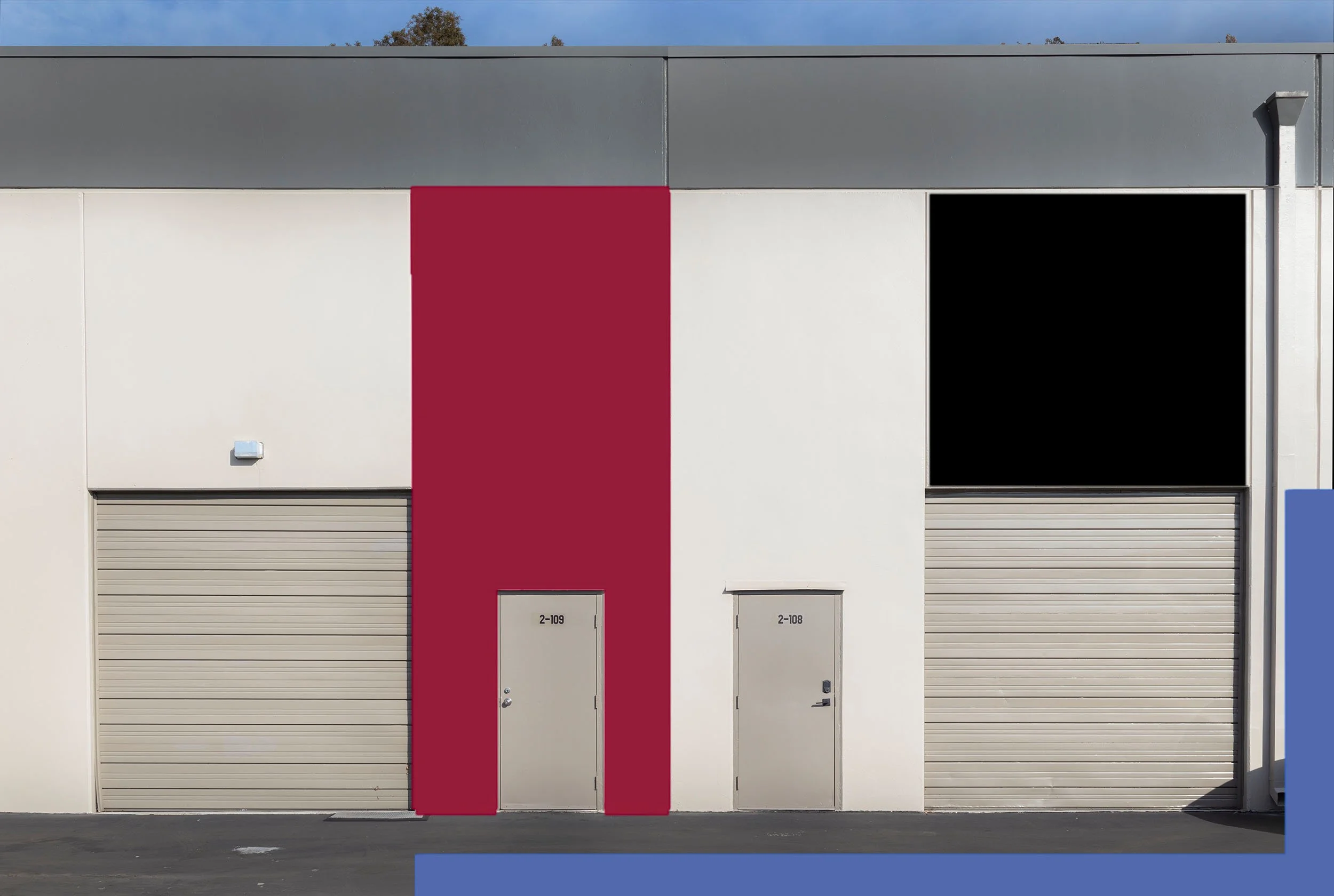
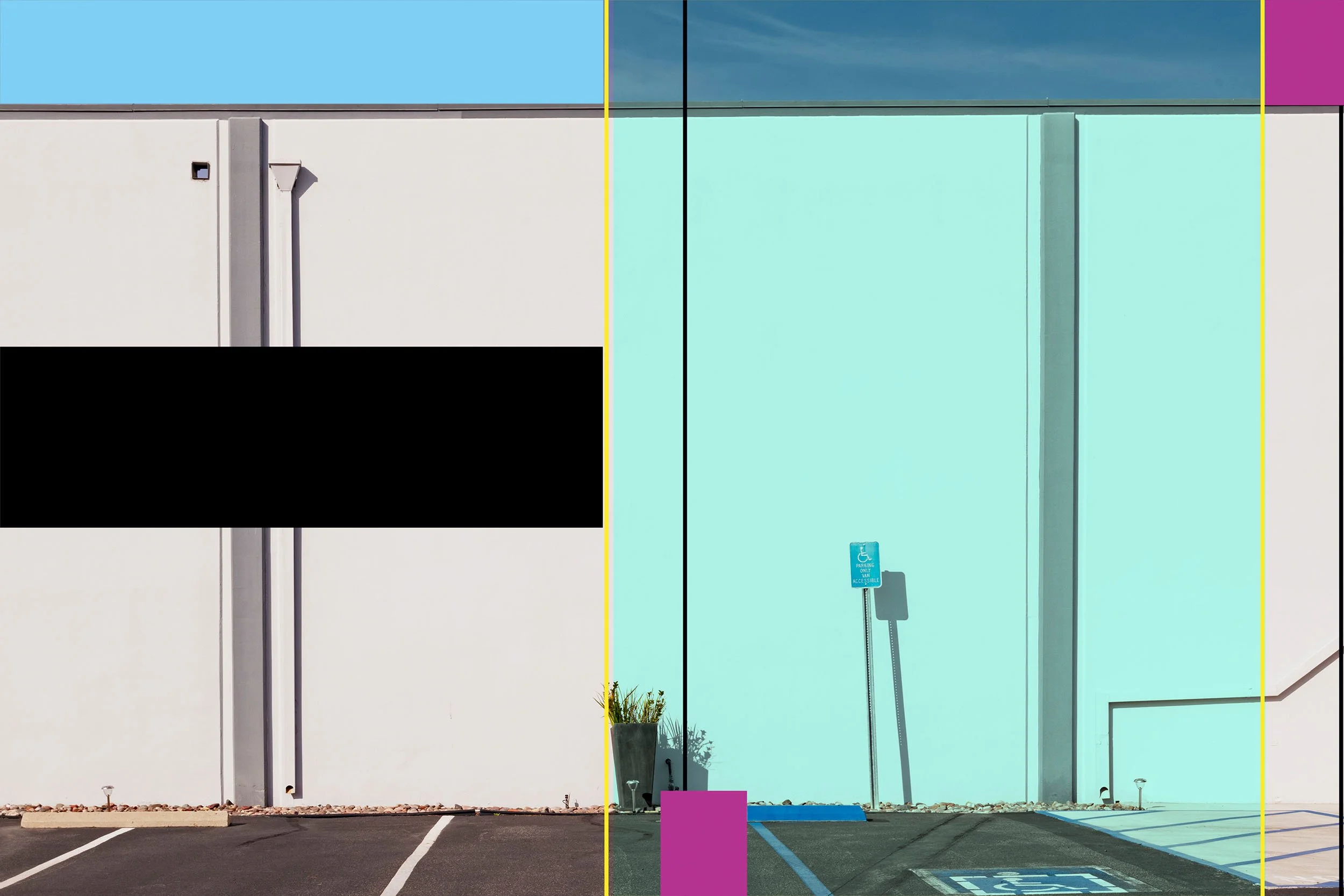
Baltz # 31(2025) and Baltz #6 (2025)
In 2024, Crawford happens to find himself looking through his first edition of Baltz’s seminal book The New Industrial Parks Near Irvine California (1974). Crawford emphasizing that this book “in terms of photography was one of the most important books, up there with Robert Frank’s The Americans.” Flipping through its pages, he noticed something most viewers overlook; on the blank facing pages, Baltz had included in small print in the corner of the page, precise addresses and orientation details for each photographed site. “It was like breadcrumbs.” Crawford recalls. “All this information he left here and I was thinking, isn’t this interesting? It is a conceptual kind of book where you have two pages, one with a photograph and the other side with information hidden in what looked like nothing there.”
Those breadcrumbs initiated a temporal dialogue. Crawford said he just knew what he had to do in that moment. “Wow, fifty years, let me try and drive by a couple of these locations, because at that point I am literally sitting a few miles from them (in his studio). I went by, looked, went by again, looked, and said to myself, I have got to re-photograph these. I have to bring these current locations, to document them, and then have them interact with my idea of active perception and my language of abstraction, which I've used for decades, and meld that together with Lewis's original work.” Crawford tipped his prints into Baltz’s book. Using it as form, he set the stage for a performance of abstraction that he believes viewers today are more ready to understand than they were fifty years ago.
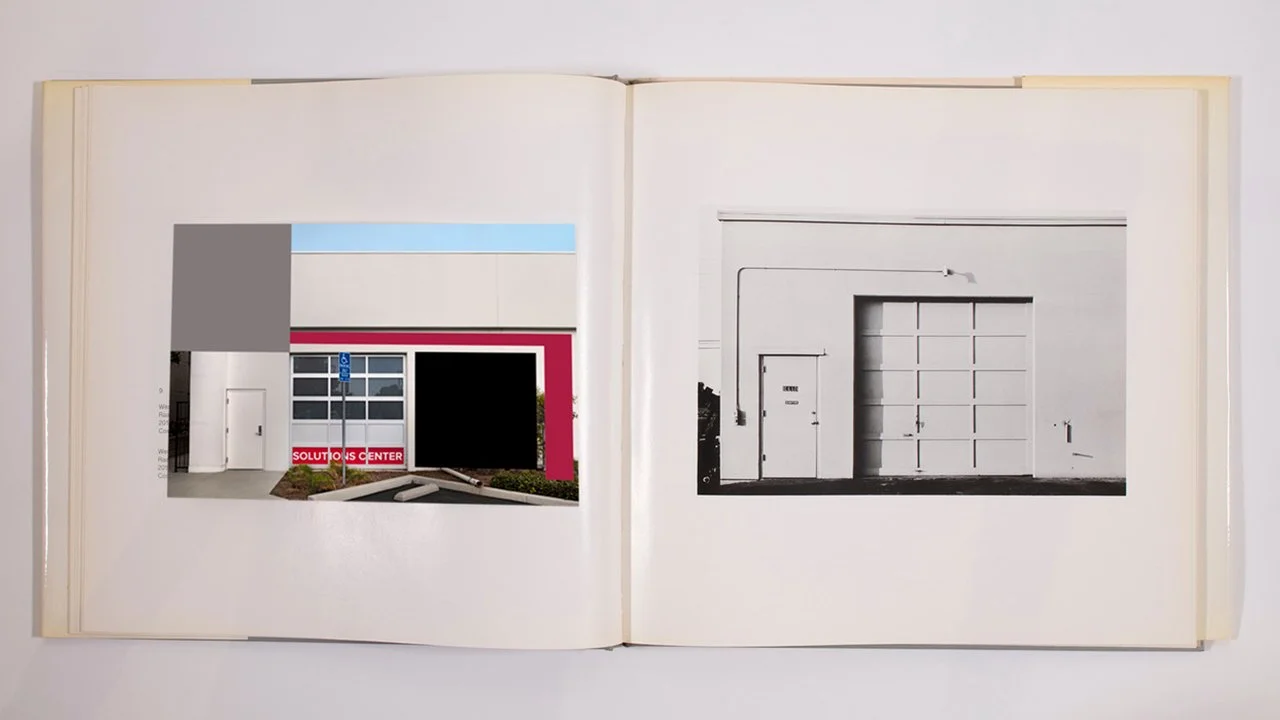
On left page: Crawford’s print of Baltz’s original site tipped in over the printed address, On right side: Baltz’s original image
The photographs he made do not attempt to replicate Baltz’s unromanticized black-and-white language. Instead, they introduce Crawford’s own long-developed, unique visual vocabulary of fields of saturated color, geometric forms, and carefully controlled gradients interacting with the photographed environment.
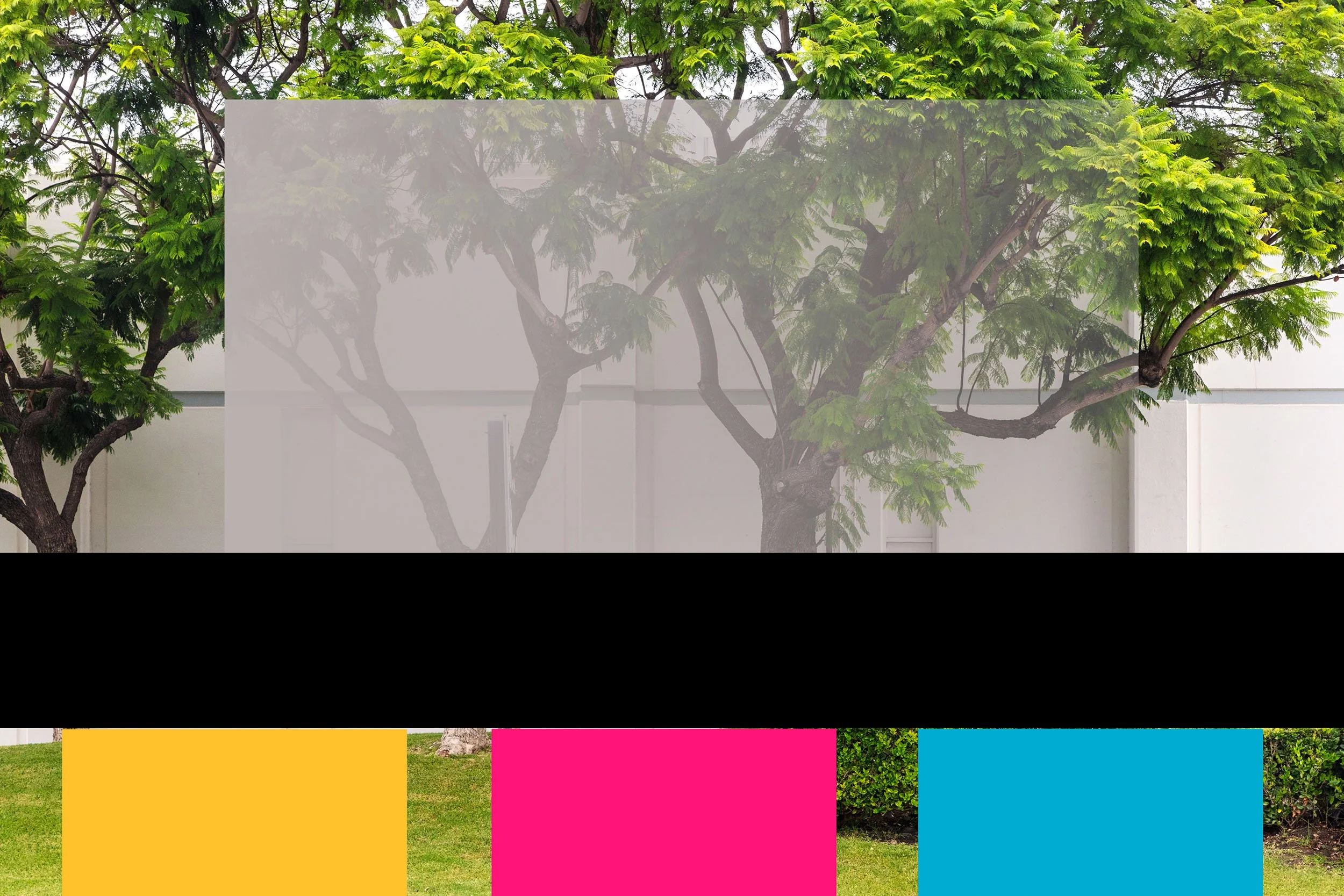
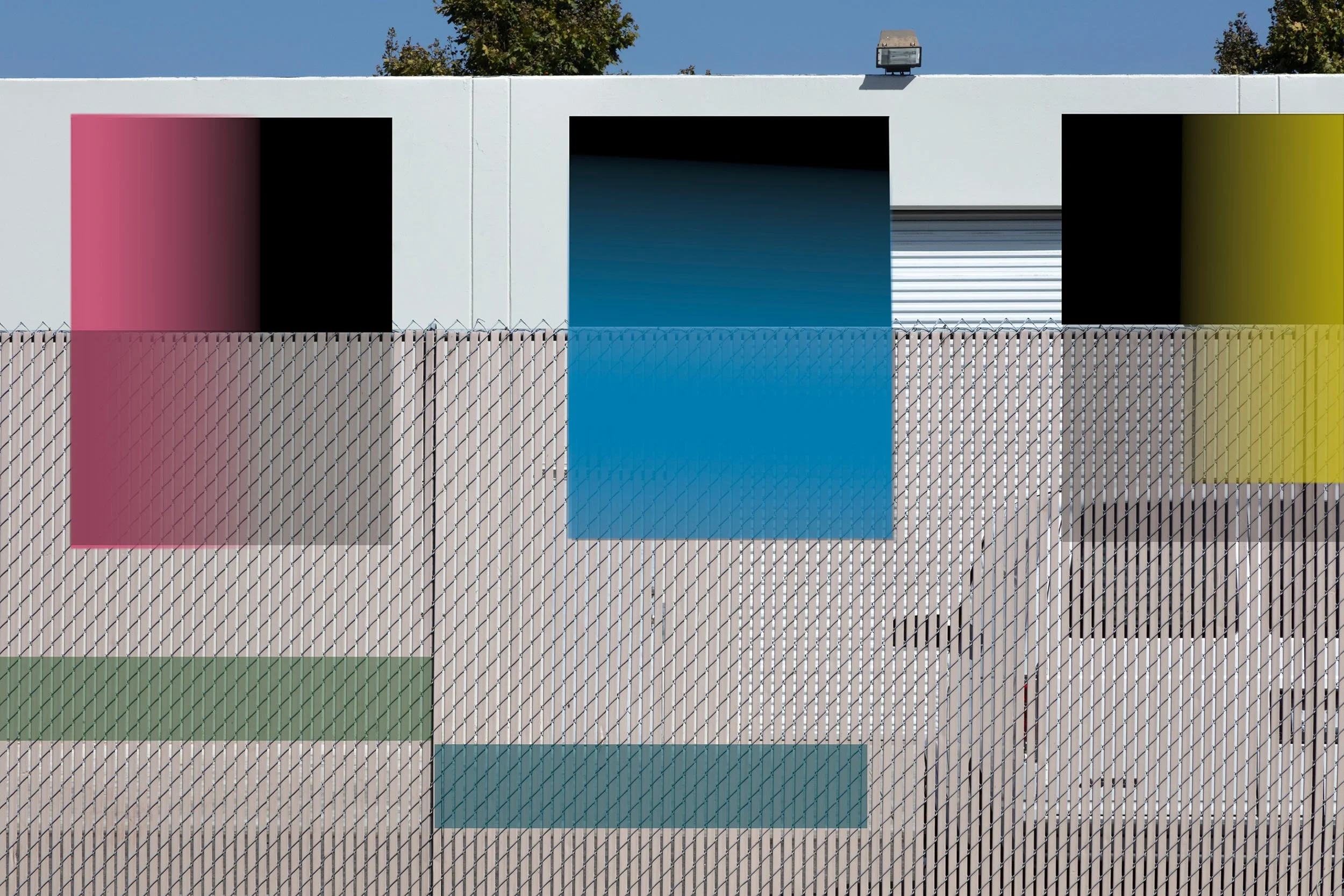
Baltz #4, 2025 and Baltz #51, 2025
Installed in grids on a wall that echoes Baltz’s original presentation, the works invite viewers to move through them nonlinearly, letting the eye wander rather than follow a traditional fixed sequence. The grid itself becomes a time-based field: a structure that allows perception to pause, skip, and double back. Baltz (2025) carries the weight of collaboration over time - two artists with similar backgrounds and points of view, separated by fifty years. In this way, Crawford’s series is less about revisiting places than about revisiting perception. It asks what it means to encounter the same site over time - not only in physical terms, but in the context of evolving photography technologies, visual languages, as well as the historical and contemporary fine arts’ cultural assumptions made about conceptual photography in the 1970s and early 80s.
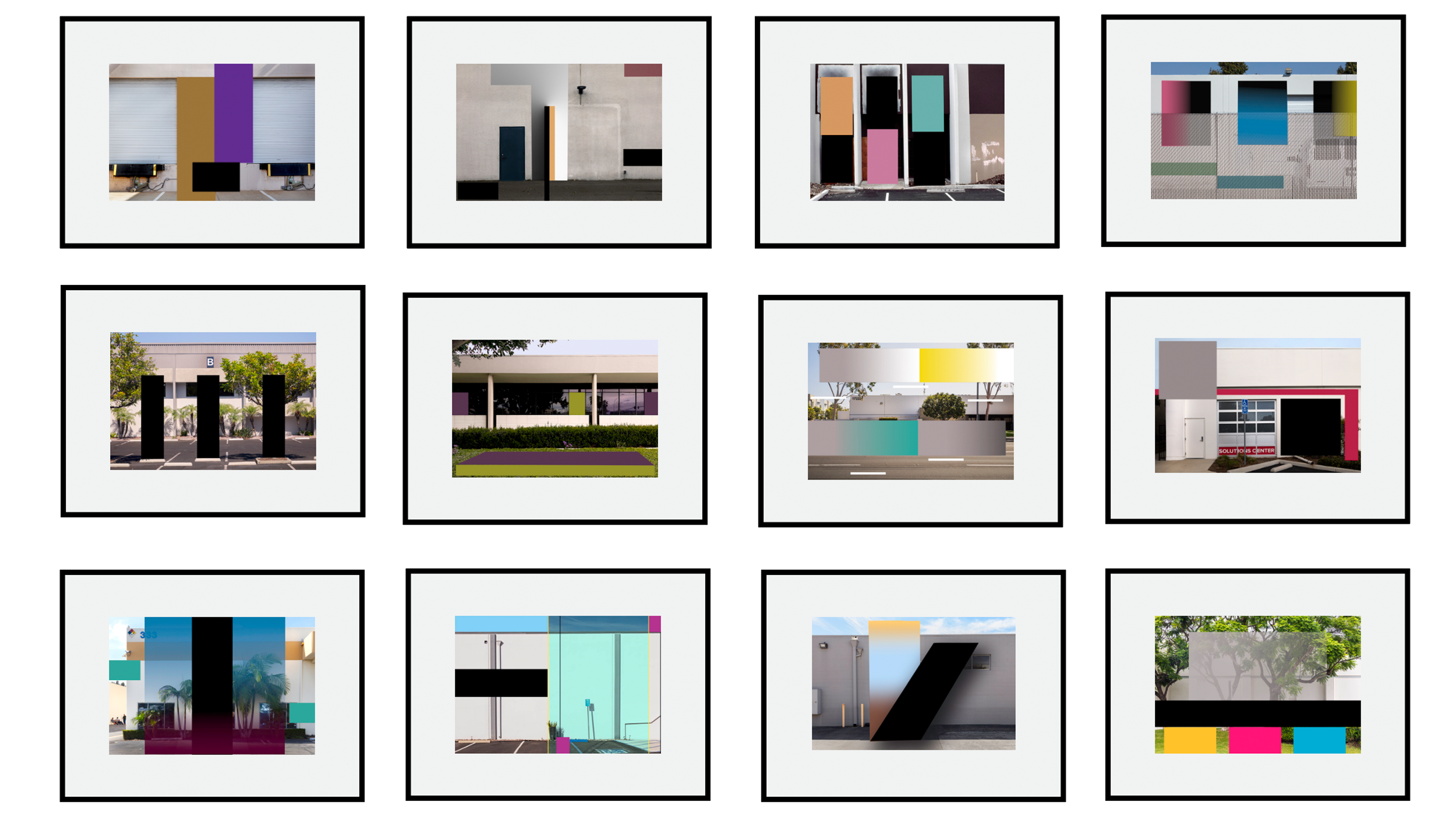
Installation Grid View of Baltz (2025) at Paris Photo 2025
For Crawford, the roots of this inquiry go back to his adolescence. Growing up in Southern California during the 1960s, living in his neighborhood was a community of hard-edge abstract painters known as the Four Classicists. Visiting John McLaughlin and Karl Benjamin’s studios (he was friends with Benjamin’s son), he experienced abstraction not as distant art history but as a living language. “Here was a language of abstraction that I thought, I want to participate in – I want to paint,” he recalls. Yet even then, he sensed a temporal tension. Painting, for all its expressive power, felt tied to an earlier era. “Abstract painting in a studio seemed historical. The process did not reflect the life I was living, of what was happening (in my time).”
Crawford’s early realization became a pivotal turning point. Rather than choosing between abstraction and imagery, he began to think of both as languages, where photography could offer a way to merge them to tell new stories. He later described this as “visual bilingualism,” combining the descriptive language of images with the structural language of abstraction. This bilingual approach was inherently temporal. It allowed him to speak about his present moment without becoming trapped in historical conventions. It also enabled him to address a fundamental paradox of photography: its capacity to freeze time while simultaneously revealing that nothing is ever truly still.
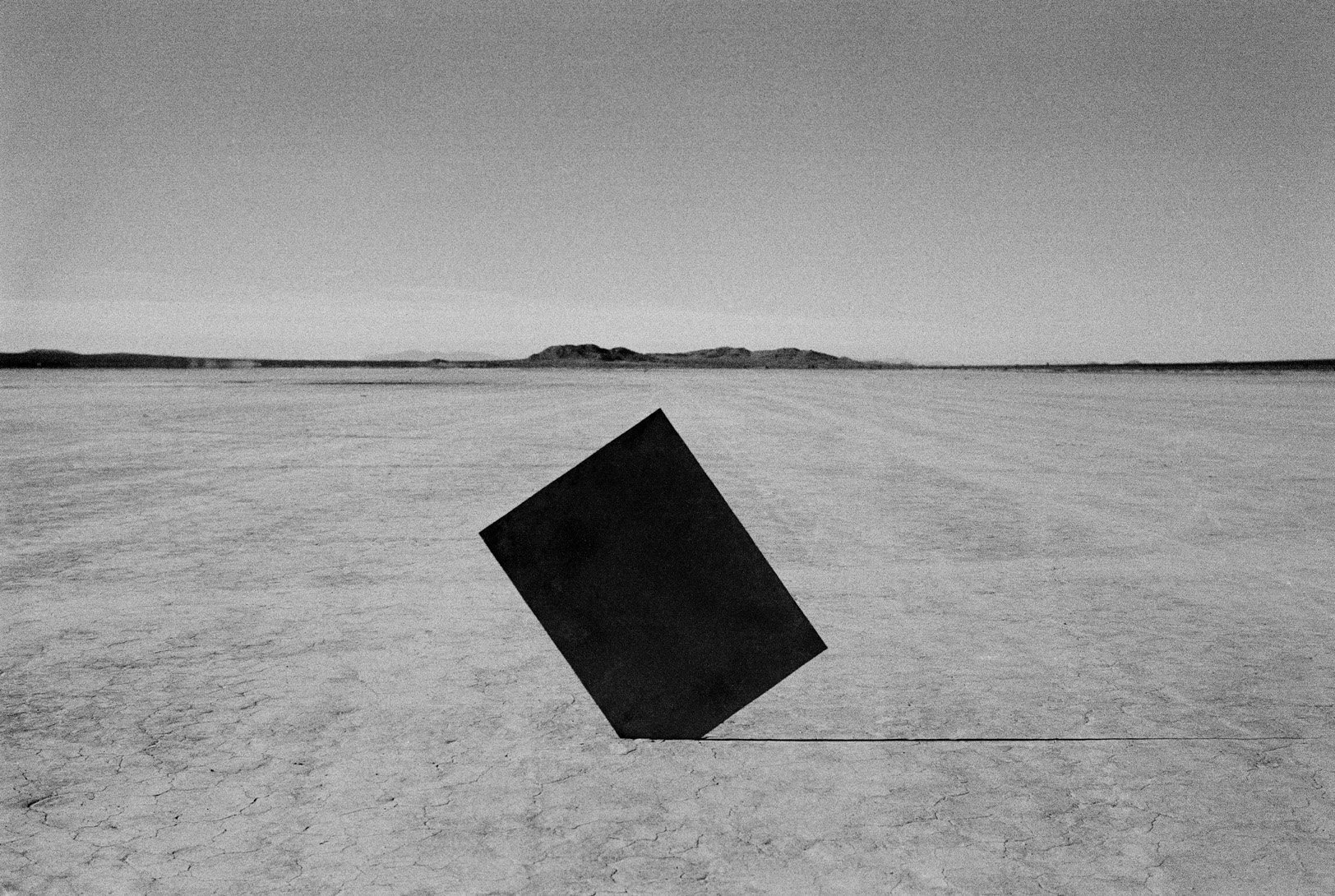
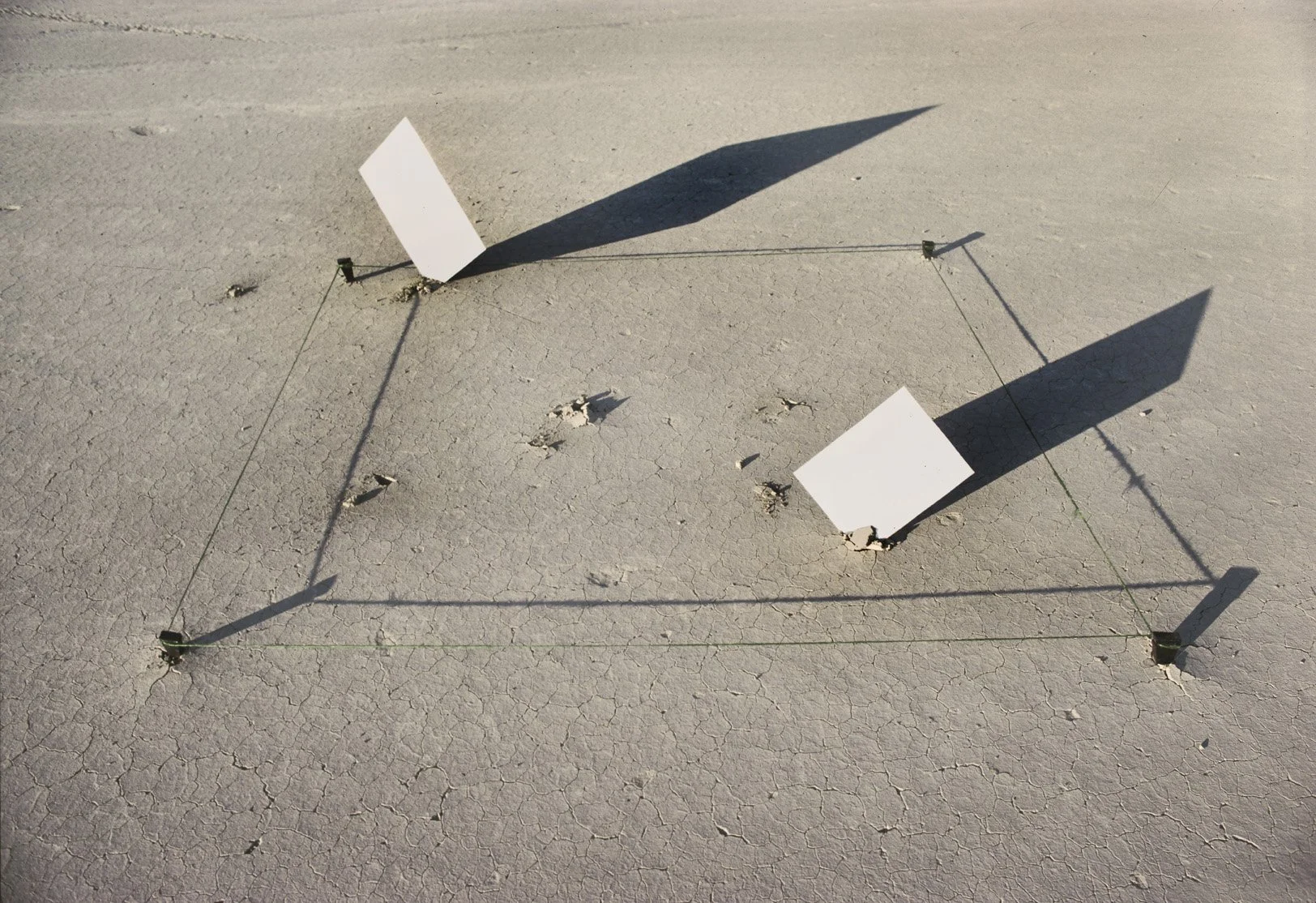
El Mirage #1 (1976) and El Mirage #46 (1976)
Crawford’s understanding of time is inseparable from place. Southern California’s landscape, with its intense, high contrast light effects and vast deserts, instilled in him an acute awareness of duration and change. In the desert, he notes, one experiences “consistent contact with the earth – feeling grounded.” One can also see for miles — a spatial openness that heightens the perception of time passing and plays with scale. His later move to Rochester, New York, for undergraduate studies at the Rochester Institute of Technology (RIT) introduced a contrasting temporal environment. There, seasonal shifts, dense vegetation, and the city’s deep photographic history, where Kodak and the George Eastman Museum were located, created a sense of layered time. “You really get the sense of history,” he recalls. He continues to describe how walking on leaf-covered ground created a separation, feeling ungrounded. It seemed to be like stepping through accumulated years of experience rather than touching the present moment directly. This juxtaposition between environments — the expansive immediacy of the Southern Californian desert and the historical density of the Northeast — shaped his perception of photography as a medium that could both record and construct temporal experience.
In the early 1970s at RIT, Crawford’s education unfolded within an intensely collaborative ecosystem. Scientists, photographers, printmakers, and conceptual artists intersected daily, blurring disciplinary boundaries. For Crawford, technical training in chemistry and optics did not restrict creative exploration but instead expanded it. Understanding the behavior of silver molecules, for example, allowed him to experiment with toning processes and alternative color effects in novel ways. The darkroom became his laboratory, where he could spend many hours experimenting.
Equally influential at RIT was the broader, open, artistic environment that gave him access to courses in philosophy, history and collaborative studio work like at the Visual Studies Workshop (VSW); where artists would be working with found object collaging and self-made photo books, challenging the popular automatic nature of taking the snapshot. Co-founders Nathan and Joan Lyons fostered a culture of experimentation in which photography was treated not merely as a recording tool but as a conceptual medium. Betty Hahn and Bea Nettles to name a few of the greats, used mixed-media and photographic processes such as stitching, kitchen chemistry and sculpture. Albert Paley, another pioneering artist, expanded the possibilities of metalworking on an architectural scale.
Crawford recalls being asked, “What more could be done with a photograph?”as a material object, as a narrative structure, or as form of visual language, realizing “I better start thinking a bit deeper here!” Fast forward to today, visual artists in photography are similarly challenging the instantaneous nature of the taking a selfie with making images using mixed-media and alternative processes that slows the creative act.
This collaborative atmosphere continued during Crawford’s graduate studies at the prestigious Claremont Graduate School in 1975, where he also became the artists’ photographer, given his rigorous technical training at RIT. Crawford was asked to document artists’ works for their own records and exhibition posters, passing through the studios of American pioneering artists of their crafts such as Sam Maloof (furniture design), Paul Soldner (ceramics) and Michael Brewster (acoustic sculpture) to name a few. However, it was photographing the performance arts and installations—ephemeral practices— that profoundly altered his understanding of time. Through this experience, Crawford came to understand photography as a time-based art form, extending moments that would otherwise vanish. “Once it's done, it's over, and the only thing left is the photograph. Wow. Well, why don't I go to the desert and start working with me in that same vein.”
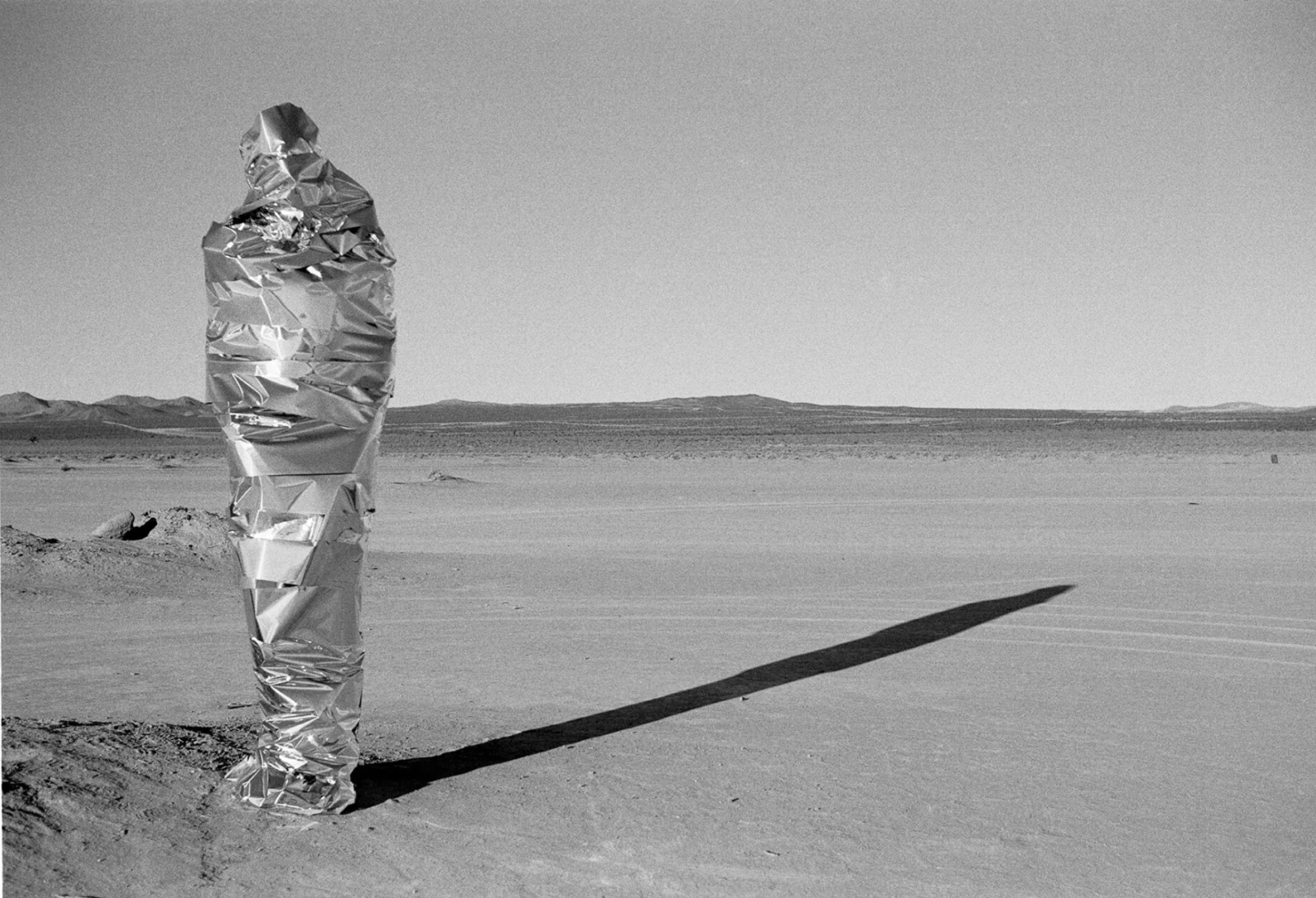
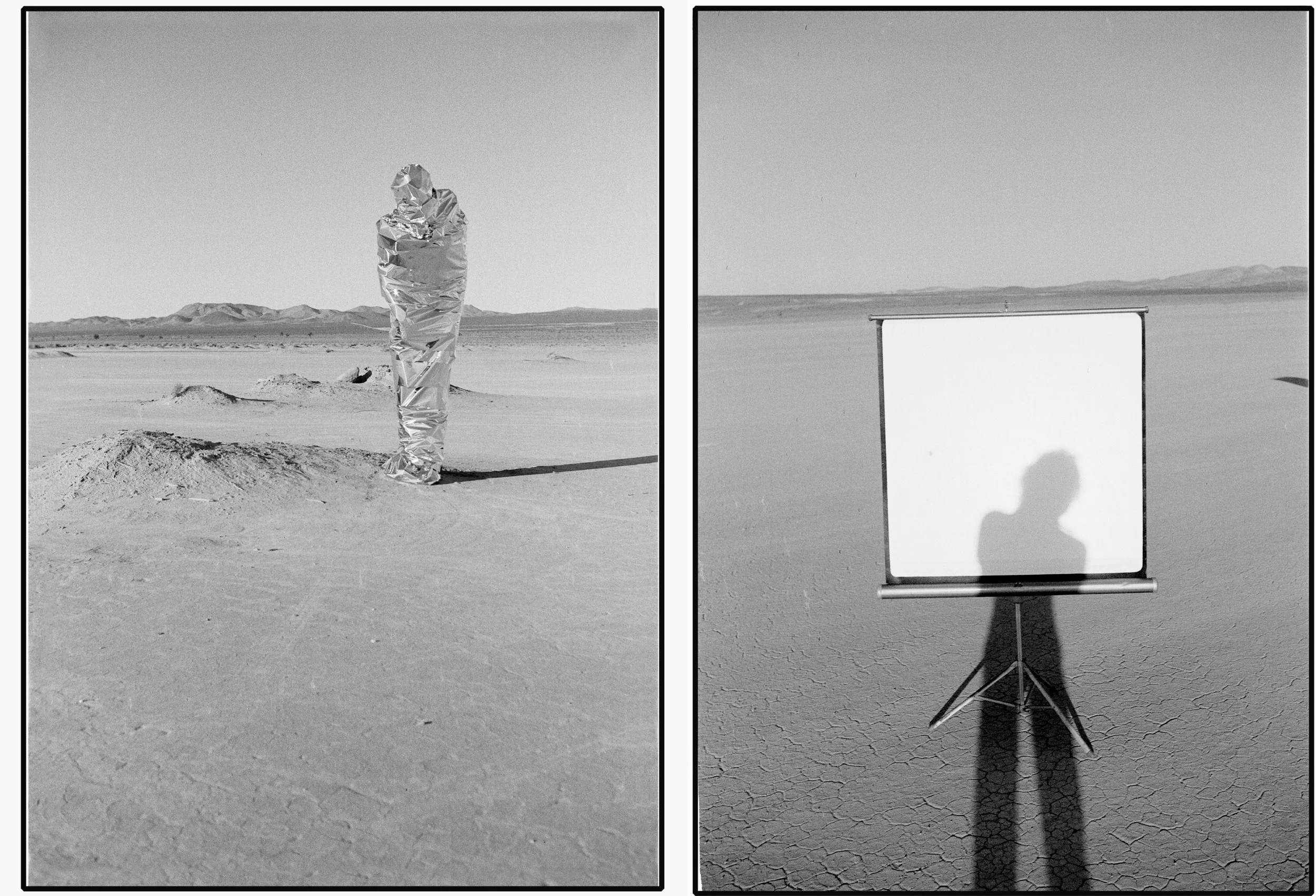
Transfigurations (1973-74)
This insight became central to Crawford’s early series, Transfigurations (1973-75), where for some of his images, the Mojave Desert became his stage, wrapped in foil making self-portraits under the passing sun. In El Mirage (1975–78), Crawford used objects in a similar performance, experimenting in ways that extended his way of playing with time and space. In these works, geometrically shaped metallic and glass sheets were placed within the desert landscape to interact with shifting light and perspective - transforming static forms into shape-events.
Rather than documenting them as installations, Crawford noticed that the photographs themselves constituted the performance, capturing fleeting alignments and playing with scale, between object, environment, and perception. It revealed Crawford’s enduring fascination with time as an active force within visual experience and perception, what he often refers to as active perception. The shapes appear to move across the picture plane, not because they physically change position, but because the viewer’s perception shifts in response to light, color, and compositional rhythm. For him, using photography rather than digging up the desert to create these images was more intriguing and conceptual.
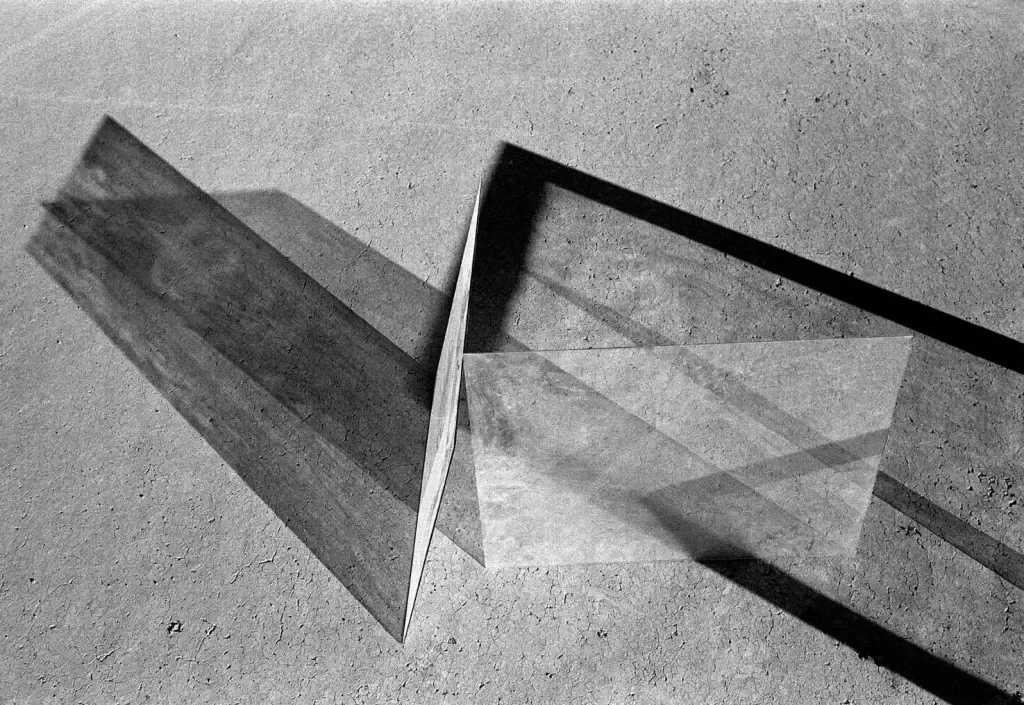
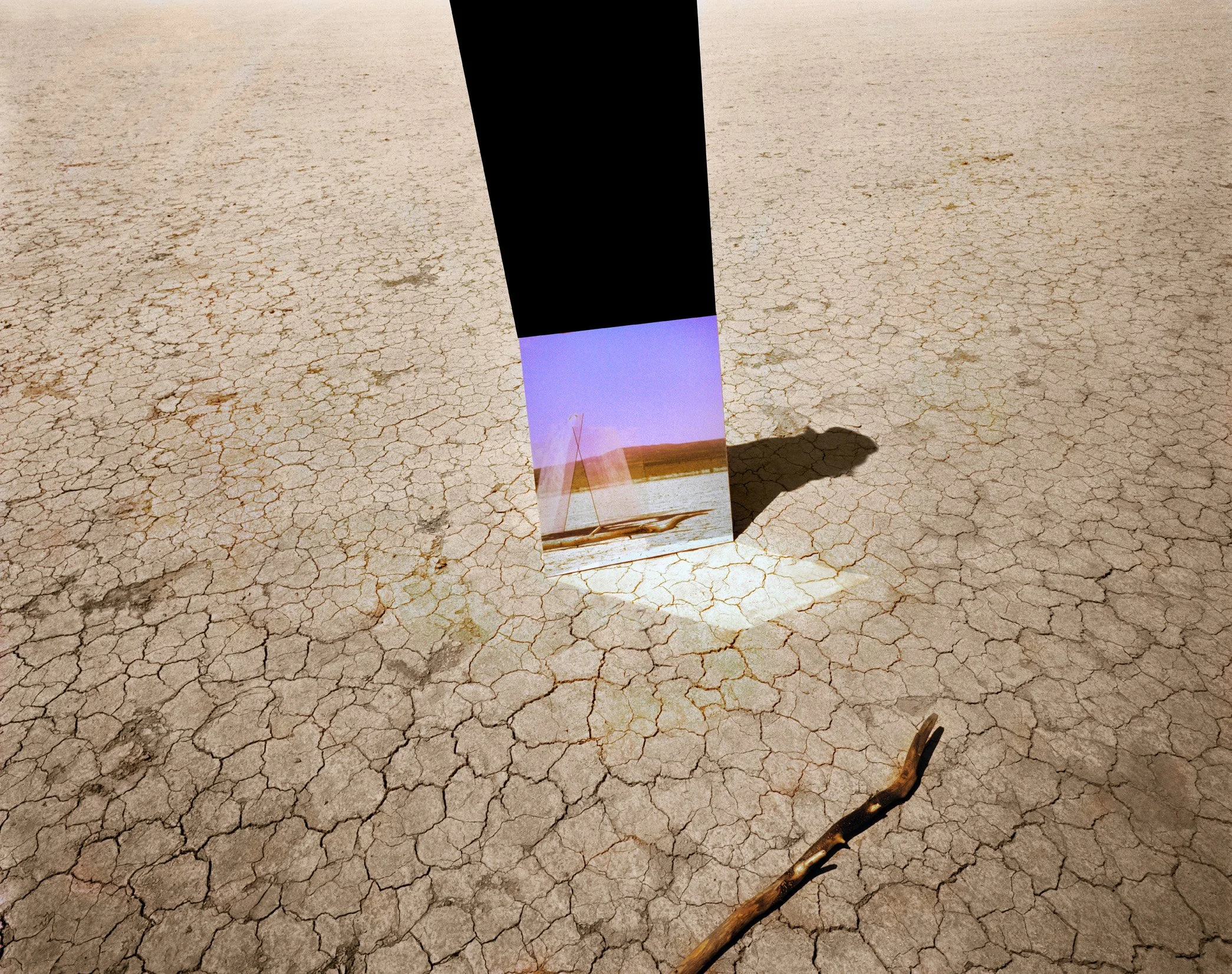
El Mirage #23 (1977) and El Mirage #58 (1976)
It is the visual language of active perception that lays at the heart of Crawford’s practice. He challenges the conventional assumption that photography presents objective truth, arguing instead that perception is always shaped by subjective factors—emotions, expectations, and cultural context. “We’re half the world that we perceive,” he explains. To express this idea, he describes his work as a form of visual poetry. Shapes and colors interact like words and rhythms, sometimes harmonizing, sometimes creating a “back and forth” tension. This poetic framework reinforces the temporal dimension of his images: they unfold gradually as viewers move their eyes across the surface, discovering relationships that cannot be grasped or understood in a single, representational glance.
Next in the evolution of Crawford’s thinking was his series Umbra (1975-79). Crawford’s innovative use of darkroom masking techniques exemplified his process-oriented approach and continues into Baltz (2025). Laughingly, he reflects, “I was just making things up!” By selectively blocking light during exposure with handmade paper cutout geometric shapes, he created precise tonal effects that transformed photographic space into a stage where a performance of visual decision-making could be directed.
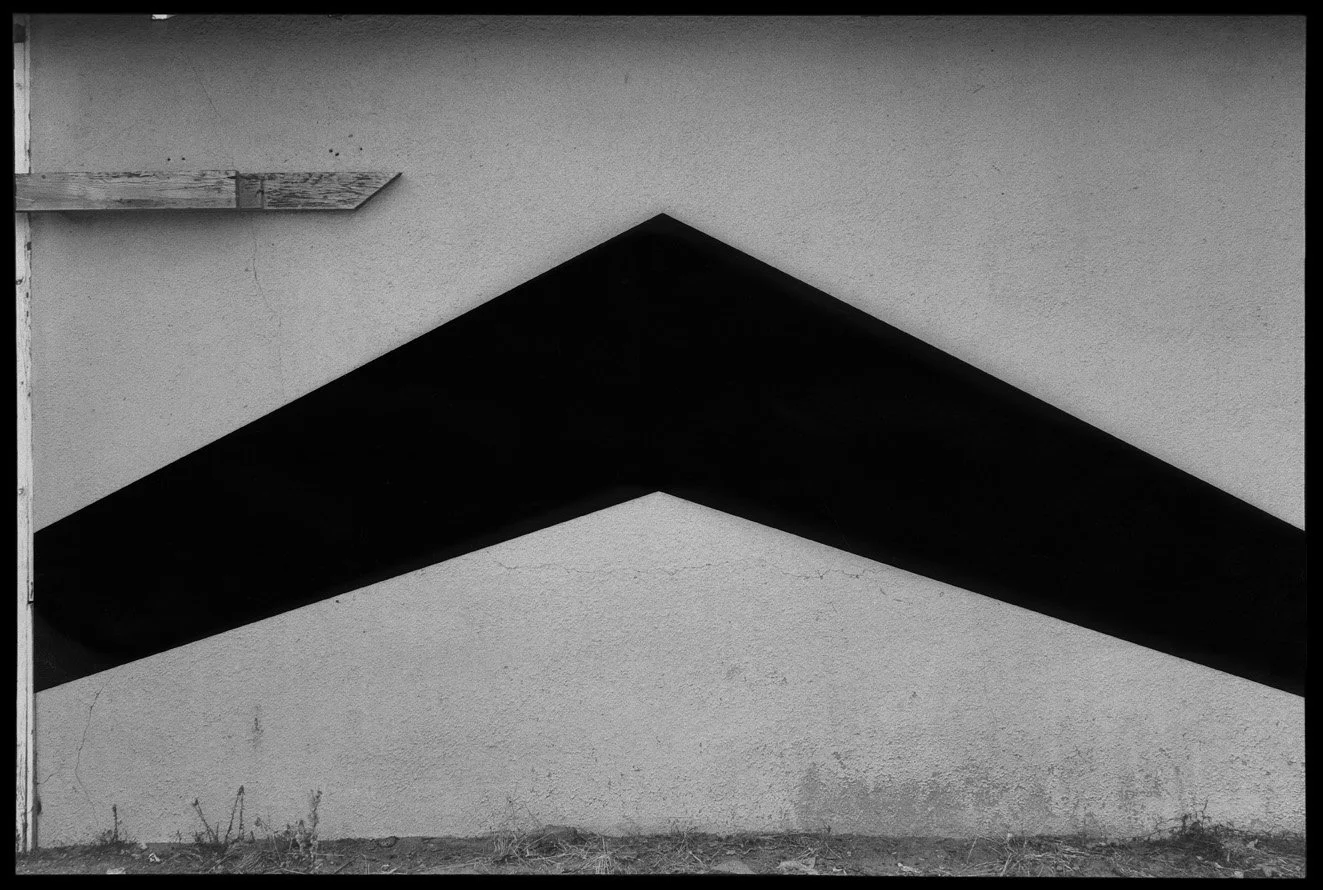
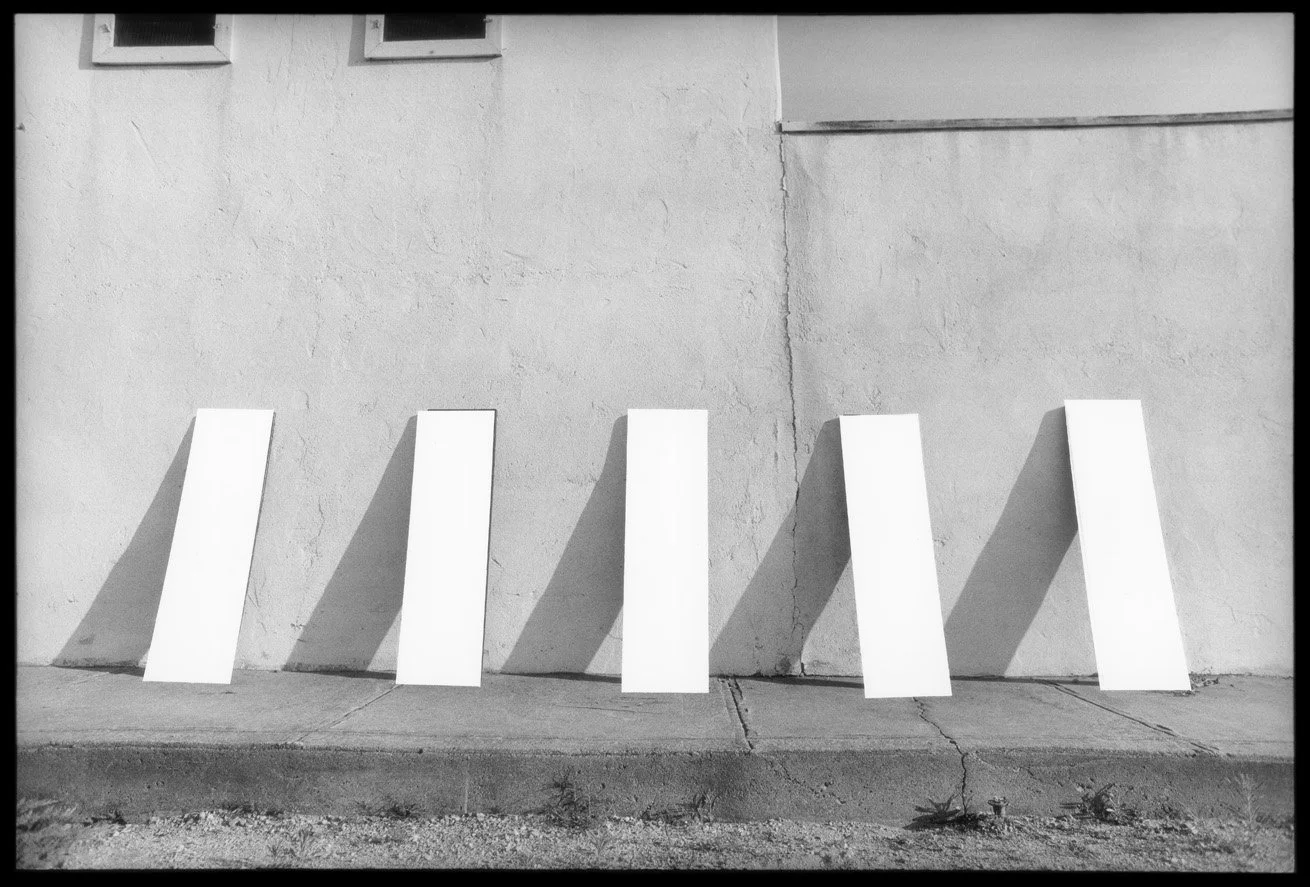
Umbra #4 (1975-79) and Umbra #20 (1975-79)
Over time, he came to view masking not merely as a technical procedure but as a conceptual model for perception itself. “Masking is a way of thinking, it’s the way we look out at the world,” he comes to realize as he speaks, noting how digital technologies have since made such processes and ways of thinking commonplace and intuitive. He emphasizes that where techniques once required painstaking manual experimentation now exist as instantaneous digital tools, reflecting broader shifts in technological and cultural time.
In Chroma (1978–84), Crawford introduced color as a central element of his visual language – a language that stays with Baltz (2025). Inspired by Mexico’s renowned architect Luis Barragán’s use of saturated color to define the volume and mood of a space, Crawford experimented with developing methods for creating handmade graduated color fields (linear gradients in digital terminology) by shifting color plastics under the enlarger to interact with photographic imagery – an innovative way of using gradients for his time. Trained at RIT by John Pfahl, an American pioneer of color photography, color for Crawford became an emotional experience and a temporal dimension - an element that guided perception across the image, creating a sense of movement and duration. It became an emotive shape-event. He describes black-and-white photography as akin to a fugue, while color resembles a symphony: expansive,emotionally resonant, and capable of sustaining complex visual narratives.
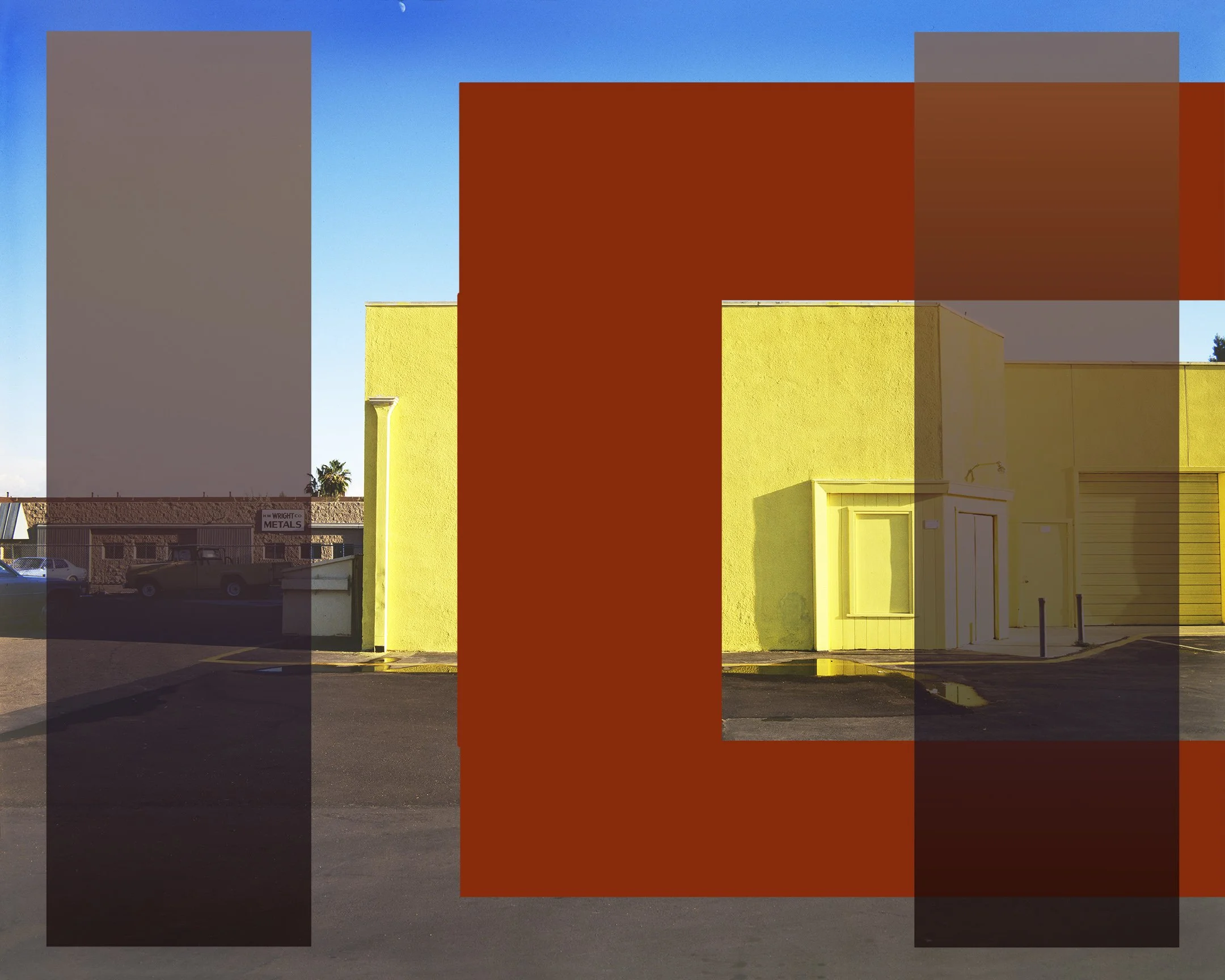
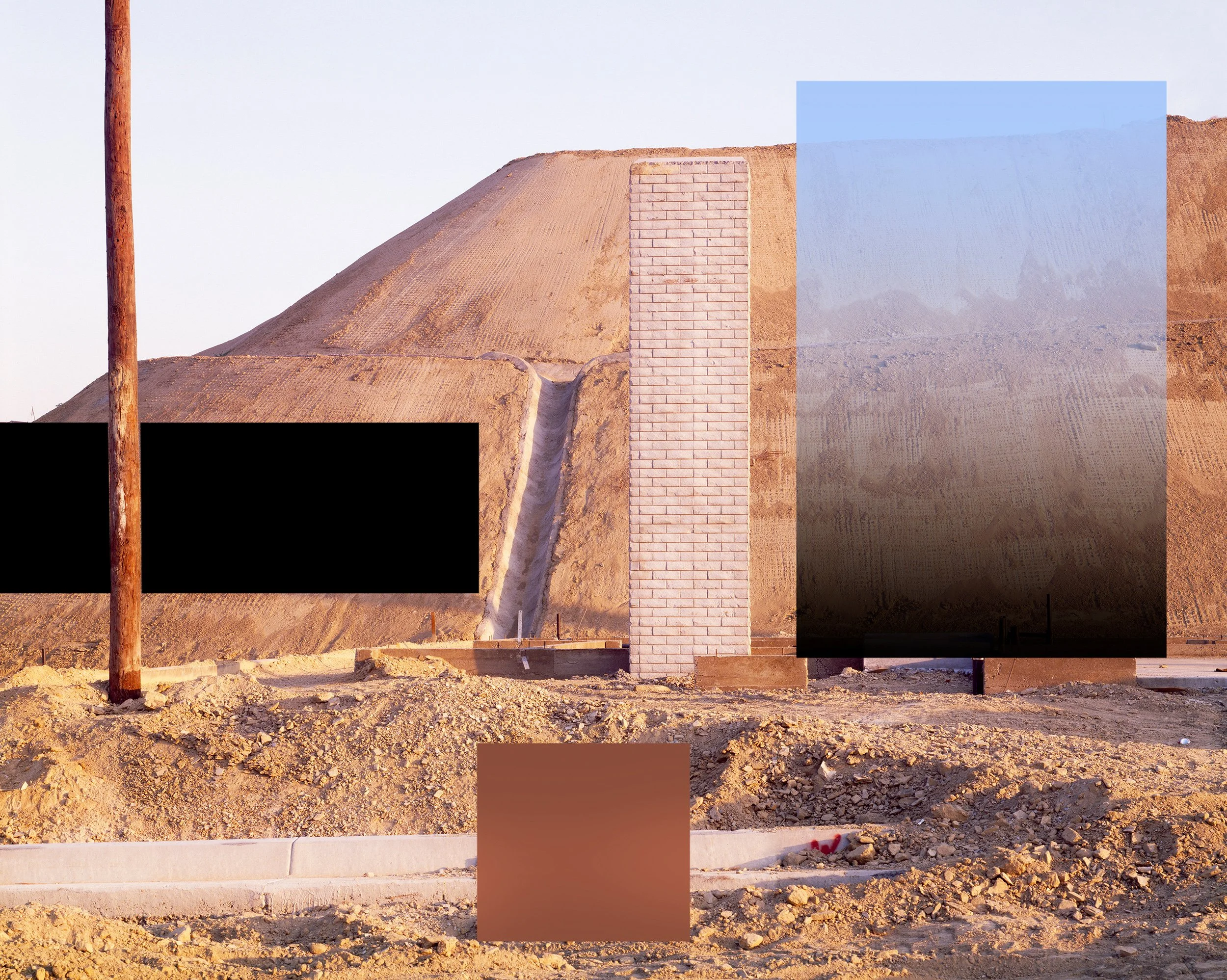
Chroma #141 (1981-2019) and Chroma #180 (1981-2019)
In a final return to Baltz (2025), all these themes converge. By revisiting sites photographed half a century earlier, Crawford engages directly with time’s layered nature. The Southern Californian landscapes he encounters have changed; fields replaced by buildings, structures repeatedly demolished and rebuilt, and yet the act of standing in the same location creates a continuity that transcends physical transformation.
The series also reflects Crawford’s career trajectory, marked by periods of visibility and relative absence. His recent reemergence mirrors the temporal cycles he explores in his work, suggesting that recognition itself shifts over time. When Crawford was developing his most experimental work in the early 1970s, the fine art world largely regarded photography as a mechanistic craft rather than a conceptual medium. His practice, combining abstraction, scientific processes, and time-based thinking, did not fit existing categories.
“It confused people,” he recalls. “To photographers it wasn’t photography, and to painting galleries it wasn’t painting either.” While some gallerists expressed interest, they recognized the difficulty of sustaining a market for work that audiences were not yet ready to perceive. Crawford could respect this. He continued to support his practice by photographing well-known artists or their art (i.e. photographer Ed Ruscha, architect Frank Gehry). He worked for museums as well, extending the life of time-based art.
Decades later, as digital culture normalized the perceptual strategies he had pioneered by hand, his work has begun to be reexamined through books, collections (Getty Museum, USA, LACMA, USA, Albright-Knox Art Gallery, USA, Turku Museum, FI) and international exhibitions.

Ultimately, Baltz functions as both conclusion and continuation. It gathers the visual languages, processes, and conceptual inquiries Crawford has developed over five decades, while simultaneously opening new possibilities for dialogue between the past and present. As he reflects on the project, Crawford returns to the idea that has guided his practice from the beginning: that photography does not halt time but reveals its ongoing movement. The frame, he suggests, is not a boundary but a point of intersection—where perception, memory, and change converge.
In this sense, Baltz does not simply revisit history. It demonstrates how history itself remains in motion, continually reshaped by the ways we see and remember. And so, the series ends where it began: with Grey Crawford standing at a familiar coordinate, looking at a landscape that is both the same and entirely transformed — aware that, even as the shutter clicks, time continues to move beyond the frame.
About the author:
Shaheen Lakhani is a conceptual visual artist based in Cambridge, Massachusetts. Her work observes the everyday with quiet attention, exploring the tracing of connection and the intimacy of shared experience within an unbounded presence. In 2024–2025, her images were selected for Winter Solstice Member Exhibitions at the Griffin Museum of Photography, MA; the online LensCulture Emerging Talent Competition Gallery Editors’ Picks and for the juried Summer 2025 The Curated Fridge exhibition, MA.
artist info
Website
represented by Persons Projects
News:
Exhibition: Geometry of Light- Grey Crawford | Karl Benjamin at Persons Projects in Berlin, Germany
Opening: Friday 01 May 2026, 6 - 9 pm
Book release at Photo London May 14-17, 2026: Grey Crawford - Chroma 1978-85 Vol. 2 at Beam Editions